CCNA #039 - OSPF DR, BR and DROTHER Election - do you know the answers?
Skills:
Network Security70%
Key Takeaways
Explains OSPF DR, BDR, and DROTHER election on Cisco routers
Full Transcript
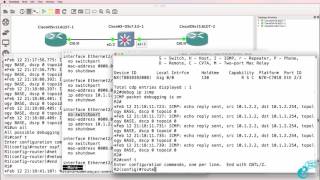
[Music] this is one of multiple videos discussing OSPF dr and BD are designated Rada and backup designated rudder elections and selection criteria on Cisco we have this document that says that DRS and BD our elections are done via the hello protocol hello packets are exchanged via multicast packets on each segment the router with the highest priority on a segment will become the dr for that segment the process is repeated for the BDR in the case of a tie the Rada with a highest rudder ID will win the default priority on an interface is 1 if you set the priority to a zero it means the rudder will not become ADR or abd are remember that the dr and BD are concepts are per multi-access segment setting the OSPF priority on an interface can be done using the IP ospf priority command now let's look at this segment that has router 3 router to router 1 and rather for connected to it on this segment writer one has neighbor relationships to writer to writer three and rather for note to the interface gigabit is zero the stop entry is for the segment on gigabit zero one but we are concentrating on gigabit to zero zero for the moment so we don't see a dr show IP ospf interface brief what we do see is that the local radda radda one is the designated writer now that goes against what we've just read the Rana idea of the sraddha is lower than the other rod is on the segment and this is where real world comes into play versus theory the reason why Rada one was elected as the designated router is that in the previous video I configured Rada 1 first before I configured the other routers so Rada 1 was the only rudder on the segment it was waiting for other routers none appeared so it became the dr when the other riders were added to the segment and i added them in the order of router - then router 3 then router for radha one was already the designated router once a designated route is elected and a writer comes onto the segment with a higher priority or higher rod ID it's not going to usurp or preempt the designated router the designated router remains the designated router and hence the local router with a lower rod ID which we can see by using the command show IP ospf interface is elected as the dr on gigabyte zero zero it came online first has an adjacency or neighbor relationship with three routers router 2 is the backup designate errata router 3 and router 4 r dr others show IP ospf and neighbor routed to is a BDR router 3 router for or dr others on gigabit 0 0 so what happens if we go on to gigabit to 0 0 and we type IP ospf priority 0 show IP ospf interface is the rod estate on gigabit to zero zero has changed 2d or other it's now formed a full relationship to router 2 so show IP ospf neighbor Radha 1 has a full relationship to brought a 2 as well as router for the reason why routed to became the dr is it was already the BTR and then out of rudder 3 and rata for router for became the BTR because it had a higher radha ID so the theory is as follows right over the highest priority becomes designated router on a segment that's not entirely true if one router comes onto the segment first before other routers that router will be the designated router but if they all come online at the same time it's based on highest priority then highest rod ID then highest a loopback interface IP address then highest configured physical interface address and in this case Radha for became the backup designated router because it had the highest IP address so what I'm going to do now is reboot the switch so that you can see the full process of how the exam explains how Radha IDs are elected so first thing I'll do is change the priority of Rada one back to one on router 2 let's confirm the relationships so show IP ospf neighbor rather one is a DR other router 3 is idea or other router fall is a backup designated router and the local router is a designated router in the output here we can see that right of 4 he's the backup designated router router 3 and rather 1 or D or others so let's see what happens when we shut down interfaces on the switch so shut down a range of interfaces gigabit 0 to 3 so I've shut those interfaces down on Radha 1 show IP ospf neighbor now it may take it a while in genus 3 to realize that the interfaces have gone down so what I'm going to do at this point is pause the video and what we should see is that these states change so after a while the dead timer expires for the neighbor relationships previously we had these neighbor relationships and now those neighbor relationships have disappeared the only neighbor relationship that rather one has is two out of four using this Ethernet link so to ensure that it doesn't get confusing I'll shut that link down as well so we have no OSPF neighbor relationships on router one at all the switch has all of its interfaces shut down once again so let's have a look on router to show IP ospf neighbor no neighbor relationships on router to router three show IP ospf from neighbor no neighbor relationships rod a for show IP ospf neighbor it only has a neighbor relationship on the serial interface not on the ethernet interface so router for has a neighbor relationship two out of five but no other neighbor relationships so on the switch no shut we've enabled all the interfaces on the switch so Amata one after a period of time we should see that neighbor relationships are formed we can do a ping to check if the interfaces have come up interfaces are starting to come up on the switch things are now succeeding and now we see neighbor relationships three neighbor relationships have been formed on Radha once a show IP ospf neighbor Radha one has a two-way relationship - Radha - Radha for has become the designated Radha and Radha three has become the backup designated Radha the reason why writer for became the designated router is because it has the highest IP address on any physical interface this interface has an IP address of 10111 this interface one right at 2 is 10 1 1 2 the symptom router 3 is 10 1 1 3 this interface on router 4 is 10 1 1 4 but in addition it has an IP address on the serial interface of 10 1 2 1 so because it has the highest IP address of any physical interface it becomes the dr with this IP address the reason why it didn't use this IP address is because this interface was added after the OSPF process had run so the router ID had already been selected these two interfaces were up when OSPF started this interface wasn't up when OSPF was started so the rudder ID that was chosen was ten one-to-one so that proves that the radha with a highest IP address of any physical interface will become the designated router on a segment when all the devices come up let's see if we can change that by manipulating priorities I hope you've found the video useful if you enjoyed it please like it and please subscribe to my youtube channel I wish you all the very best [Music]
Original Description
OSPF Designated Router, Back Designated Router, and DR Others. Do you know the answers?
#CCNA #CCENT #CCNP
My full course is here: http://www.ccnax.com
Subscribe to learn how to pass the CCNA 200-125 exam. Also includes content for the ICND1 100-105 and ICND2 200-105 exams.
What do you want to learn? Let me know via the comments.
Watch on YouTube ↗
(saves to browser)
Sign in to unlock AI tutor explanation · ⚡30
Playlist
Uploads from David Bombal · David Bombal · 55 of 60
1
 2
2
 3
3
 4
4
 5
5
 6
6
 7
7
 8
8
 9
9
 10
10
 11
11
 12
12
 13
13
 14
14
 15
15
 16
16
 17
17
 18
18
 19
19
 20
20
 21
21
 22
22
 23
23
 24
24
 25
25
 26
26
 27
27
 28
28
 29
29
 30
30
 31
31
 32
32
 33
33
 34
34
 35
35
 36
36
 37
37
 38
38
 39
39
 40
40
 41
41
 42
42
 43
43
 44
44
 45
45
 46
46
 47
47
 48
48
 49
49
 50
50
 51
51
 52
52
 53
53
 54
54
 ▶
▶
 56
56
 57
57
 58
58
 59
59
 60
60

RYU SDN Controller Part 4: Graphical User Interface (GUI): Practical GNS3 SDN and OpenFlow
David Bombal
HPE Network Protector SDN Application Part 1 - Introduction
David Bombal
HPE Network Protector SDN Application Part 2 : DNS Interception using OpenFlow
David Bombal
HPE Network Protector SDN Application Part 3 - Lab Setup using Physical Switches
David Bombal
HPE Network Protector SDN Application Part 4 - Demo of malicious websites blocked
David Bombal
HPE Network Protector SDN Application Part 5 - Demo OpenFlow table interception flows
David Bombal
HPE Network Protector SDN Application Part 6 - Demo of Physical Switch configuration
David Bombal
HPE Network Protector SDN Application Part 7 - Demo Service Insertion Tunnel / GRE Tunnel
David Bombal
HPE Network Protector SDN Application Part 8 - Demo SDN OpenFlow Reporting
David Bombal
HPE Network Protector SDN Application Part 9 - Demo switches interception of DNS traffic
David Bombal
GNS3 Talks: GNS3 version 1.5.X Appliance Tips
David Bombal
CCNA 200-125 Exam: AAA demo: TACACS+ with GNS3
David Bombal
GNS3 2.0.0 beta 2 install
David Bombal
CCNA #012: Learn SNMP with GNS3, Wireshark and Solarwinds NPM - CCNA 200-125 exam
David Bombal
CCNA #013: Spanning Tree CCNA Exam Questions: Know the answer? CCNA 200-125 exam
David Bombal
GNS3 2.0.0 beta : GNS3 VM integration with GNS3 GUI
David Bombal
CCNA #018: Routing exam questions: Who wins? OSPF, EIGRP or RIP? Sure? CCNA 200-125 exam
David Bombal
CCNA #019: Spanning Tree CCNA Exam Questions: Root Bridge, Root Port and more: CCNA 200-125 exam
David Bombal
GNS3 Download, installation and configuration - GNS3 1.5.3 and Windows 10
David Bombal
CCNA #023 EIGRP Neighbor Troubleshooting (DUAL Issues) for the CCNA 200-125 Exam
David Bombal
GNS3 2.0 Architecture and schema Part 1: What is the GNS3 Controller?
David Bombal
GNS3 2.0 Architecture and schema Part 2: Emulators and virtualization
David Bombal
CCNA #028 VTP Troubleshooting for the CCNA 200-125 Exam
David Bombal
CCNA #029 VTP & DTP Troubleshooting for the CCNA 200-125 Exam
David Bombal
CCNA #030 VTP Troubleshooting for the CCNA 200-125 Exam
David Bombal
GNS3 : How to download Cisco IOS images and VIRL images. Which is the best? How do you get them?
David Bombal
GNS3 ASA setup: Import and configure Cisco ASAv with GNS3
David Bombal
GNS3 switching setup and options: Cisco and other switching options in GNS3
David Bombal
GNS3 switching setup and options Part 2: GNS3 unmanaged built-in switch
David Bombal
GNS3 switching setup and options Part 3: Router on a sick with GNS3 unmanaged built-in switch
David Bombal
GNS3 switching setup and options Part 4: Etherswitch Router for Cisco Dynamips Part 1
David Bombal
GNS3 switching setup and options Part 5: Etherswitch Router for Cisco Dynamips Part 2
David Bombal
GNS3 switching setup and options Part 6: Etherswitch, Wireshark, 802.1Q, InterVLAN routing
David Bombal
GNS3 Talks: Docker, Open vSwitch, SDN and OpenFlow Part 1: GNS3 Switching Part 7
David Bombal
GNS3 Talks: Docker, Open vSwitch, SDN and OpenFlow Part 2: GNS3 Switching Part 8
David Bombal
GNS3 Talks: Docker, Open vSwitch, SDN and OpenFlow Part 3: GNS3 Switching Part 9
David Bombal
GNS3 Talks: Docker, Open vSwitch, SDN and OpenFlow Part 4: GNS3 Switching Part 10
David Bombal
GNS3 Talks: Docker, Open vSwitch, SDN and OpenFlow Part 5: GNS3 Switching Part 11
David Bombal
GNS3 Nexus (NX-OSv) switch setup and configuration Part 1: GNS3 switching options Part 12
David Bombal
GNS3 Nexus (NX-OSv) switch setup and configuration Part 2: GNS3 switching options Part 13
David Bombal
GNS3 Talks: Docker, Open vSwitch, SDN and OpenFlow Part 6: GNS3 Switching Part 14
David Bombal
GNS3 Talks: Docker, Open vSwitch, SDN and OpenFlow Part 7: GNS3 Switching Part 15
David Bombal
GNS3 Cisco CSR 1000v setup and configuration Part 1: GNS3 NFV
David Bombal
GNS3 Cisco CSR 1000v setup and configuration Part 2: GNS3 NFV
David Bombal
GNS3 Talks: Use the NAT node to connect GNS3 to the Internet easily!
David Bombal
GNS3 Talks: GNS3 2.0 RC1 is now available
David Bombal
GNS3 Talks: GNS3 2.0 Portable Projects - easily export and import GNS3 projects
David Bombal
GNS3 Talks: Multiple clients sharing projects in real time, plus console session shadowing!
David Bombal
CCNA #035 NAT Troubleshooting Scenario 1 - Can you find the issue? CCNA Exam 200-125 troubleshooting
David Bombal
CCNA #036 NAT Troubleshooting Scenario 2 - Can you find the issue? CCNA Exam 200-125 troubleshooting
David Bombal
GNS3 Talks: ESXi, GNS3 VM and KVM support Part 1: leverage servers and the cloud
David Bombal
CCNA #037 OSPF Troubleshooting - can you find the issue? CCNA Exam 200-125 troubleshooting
David Bombal
GNS3 Talks: ESXi, GNS3 VM and KVM support Part 2: leverage servers and the cloud
David Bombal
CCNA #038 NAT Troubleshooting Scenario 3 - Can you find the issue? CCNA Exam 200-125 troubleshooting
David Bombal
CCNA #039 - OSPF DR, BR and DROTHER Election - do you know the answers?
David Bombal
CCNA #040 NAT Troubleshooting Scenario 4 - Can you find the issue? CCNA Exam 200-125 troubleshooting
David Bombal
GNS3 Talks: Arista vEOS GNS3 import and configuration Part 1
David Bombal
CCNA #041 - OSPF DR, BR and DROTHER Election - do you know the answers?
David Bombal
GNS3 Talks: Arista vEOS GNS3 import and configuration Part 2
David Bombal
GNS3 Talks: ipterm: Linux, Docker, Python, SDN and more! Part 1
David Bombal
More on: Network Security
View skill →







Related Reads
📰
📰
📰
📰
Australia finds serious gaps in Big Tech’s response to child sexual abuse online
The Next Web AI
The Future of Endpoint Security: Why Visibility, Intelligence, and Automation Will Define the Next…
Medium · Cybersecurity
Why Every Cybersecurity Product Needs Enterprise-Grade Connectors in 2026
Dev.to · Shivang Patel
Malware Deep Dive: Gandcrab
Dev.to · jordanricky1604-ship-it
🎓
Tutor Explanation
 DeepCamp AI