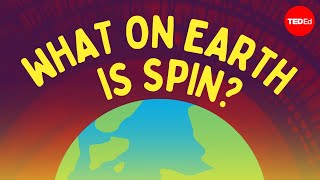
What on Earth is spin? - Brian Jones
Skills:
ML Maths Basics50%
Key Takeaways
Explains the concept of spin and its effects on our lives, including its role in physics and everyday experiences
Full Transcript
[Music] the next time you see a news report of a hurricane or a tropical storm showing high winds battering trees and houses ask yourself how did the wind get going so fast amazingly enough this is a motion that started more than 5 billion years ago but to understand why why we need to understand spin in physics we talk about two types of motion the first is straight line motion you push on something and it moves forward the second type spin involves an object rotating or turning on its axis in place an object in straight line motion will move forever unless something like the friction of the ground beneath it causes it to slow down and stop the same thing happens when you get something spinning it will keep on spinning until something stops it but the spin can speed up if an ice skat is gliding across the ice in straight line motion and she pulls her arms in she keeps on gliding at the same speed but if she is spinning on the ice and she pulls her arms in you know what happens next she spins faster this is called the conservation of angular momentum mathematically angular momentum is a product of two numbers one that gives the spin rate and one that gives the distance of the mass from the axis if something is freely spinning as one number gets bigger the other gets smaller AR arms closer spin faster arms farther spin slower spin caes other effects too if you're riding on a spinning Mig around and you toss a ball to a friend it will appear to follow a curving path it doesn't actually curve though it really goes in a straight line you were the one who was following a curving path but from your point of view the ball appears to curve we call this the Coriolis effect oh and you are riding on a spinning Mera round right now at this very moment we call it the the earth the earth spins on its axxis once each day but why does the earth spin now that's a story that starts billions of years ago a cloud of dust and gas that formed the Sun and the Earth and the planets and you and me started to collapse as gravity pulled it all together before it started to collapse This Cloud had a very gentle Spin and as it collapsed like that ice skater pulling her arms in the spin got faster and faster and everything that formed out of the cloud the sun and the planets around the sun and the moons around the planet all inherited this Spin and this inherited spin is what gives us night and day and this day night cycle is what drives our weather the Earth is warm on the daytime side cool on the nighttime side and it's warmer at the equator than at the poles the differen is in temperature make differences in air pressure and the differences in air pressure make air move they make the wind blow but because the Earth spins the moving air curves to the right in the northern hemisphere because of the Corola effects if there's a region of low pressure in the atmosphere air is pushed toward it like water going down a drain but the air curves to the right as it goes and this gives it a spin with the dramatic low pressure in a storm the air gets pulled in Tighter and Tighter so it gets going faster and faster and this is how we get the high winds of a hurricane so when you see a spinning storm on a weather report think about this the spin ultimately came from the spin of the Earth and the Earth spin is a Remnant a fossil relic of the gentle spin of the cloud of dust and gas that collapsed to make the Earth some 5 billion years ago you are watching something the spin that is older than dirt that's older than rocks that's older than the Earth itself
Original Description
View full lesson: http://ed.ted.com/lessons/what-on-earth-is-spin-brian-jones
Why does the Earth spin? Does a basketball falling from a spinning merry-go-round fall in a curve, as it appears to, or in a straight line? How can speed be manipulated while spinning? In short, why is the spinning motion so special? Brian Jones details the dizzyingly wide array of ways that spinning affects our lives.
Lesson by Brian Jones, animation by Flaming Medusa Studios.
Watch on YouTube ↗
(saves to browser)
Sign in to unlock AI tutor explanation · ⚡30
Playlist
Uploads from TED-Ed · TED-Ed · 23 of 60
1
 2
2
 3
3
 4
4
 5
5
 6
6
 7
7
 8
8
 9
9
 10
10
 11
11
 12
12
 13
13
 14
14
 15
15
 16
16
 17
17
 18
18
 19
19
 20
20
 21
21
 22
22
 ▶
▶
 24
24
 25
25
 26
26
 27
27
 28
28
 29
29
 30
30
 31
31
 32
32
 33
33
 34
34
 35
35
 36
36
 37
37
 38
38
 39
39
 40
40
 41
41
 42
42
 43
43
 44
44
 45
45
 46
46
 47
47
 48
48
 49
49
 50
50
 51
51
 52
52
 53
53
 54
54
 55
55
 56
56
 57
57
 58
58
 59
59
 60
60

Weaving narratives in museum galleries - Thomas P. Campbell
TED-Ed
Your brain is more than a bag of chemicals - David Anderson
TED-Ed
Biofuels and bioprospecting for beginners - Craig A. Kohn
TED-Ed
Four sisters in Ancient Rome - Ray Laurence
TED-Ed
The brilliance of bioluminescence - Leslie Kenna
TED-Ed
Animation basics: Homemade special effects - TED-Ed
TED-Ed
Pros and cons of public opinion polls - Jason Robert Jaffe
TED-Ed
Excuse me, may I rent your car? - Robin Chase
TED-Ed
Could tissue engineering mean personalized medicine? - Nina Tandon
TED-Ed
The arts festival revolution - David Binder
TED-Ed
What's an algorithm? - David J. Malan
TED-Ed
Why do fingers become pruney? - Mark Changizi
TED-Ed
What is fat? - George Zaidan
TED-Ed
Reasons for the seasons - Rebecca Kaplan
TED-Ed
Mysteries of vernacular: Inaugurate - Jessica Oreck
TED-Ed
Let's pool our medical data - John Wilbanks
TED-Ed
Science is for everyone, kids included - Beau Lotto and Amy O'Toole
TED-Ed
Making a TED-Ed Lesson: Concept and design
TED-Ed
Making a TED-Ed Lesson: Creative process
TED-Ed
Making a TED-Ed Lesson: Animation
TED-Ed
Is space trying to kill us? - Ron Shaneyfelt
TED-Ed
Put those smartphones away: Great tips for making your job interview count - Anna Post
TED-Ed
What on Earth is spin? - Brian Jones
TED-Ed
Gyotaku: The ancient Japanese art of printing fish - K. Erica Dodge
TED-Ed
Mining literature for deeper meanings - Amy E. Harter
TED-Ed
What doctors don't know about the drugs they prescribe - Ben Goldacre
TED-Ed
Why architects need to use their ears - Julian Treasure
TED-Ed
How do you decide where to go in a zombie apocalypse? - David Hunter
TED-Ed
Tracking grizzly bears from space - David Laskin
TED-Ed
The emergence of drama as a literary art - Mindy Ploeckelmann
TED-Ed
Why democracy matters - Rory Stewart
TED-Ed
Ethical riddles in HIV research - Boghuma Kabisen Titanji
TED-Ed
Mysteries of vernacular: Venom - Jessica Oreck and Rachael Teel
TED-Ed
Mysteries of vernacular: Dynamite - Jessica Oreck and Rachael Teel
TED-Ed
The promise of research with stem cells - Susan Solomon
TED-Ed
What color is Tuesday? Exploring synesthesia - Richard E. Cytowic
TED-Ed
How do we experience time? - Matt Danzico
TED-Ed
The contributions of female explorers - Courtney Stephens
TED-Ed
The security mirage - Bruce Schneier
TED-Ed
Mysteries of vernacular: Window - Jessica Oreck and Rachael Teel
TED-Ed
The punishable perils of plagiarism - Melissa Huseman D'Annunzio
TED-Ed
Dare to disagree - Margaret Heffernan
TED-Ed
What we're learning from online education - Daphne Koller
TED-Ed
The rise of human-computer cooperation - Shyam Sankar
TED-Ed
The happy secret to better work - Shawn Achor
TED-Ed
Dissecting Botticelli's Adoration of the Magi - James Earle
TED-Ed
The game-changing amniotic egg - April Tucker
TED-Ed
Equality, sports, and Title IX - Erin Buzuvis and Kristine Newhall
TED-Ed
Neuroscience, game theory, monkeys - Colin Camerer
TED-Ed
Why global jihad is losing - Bobby Ghosh
TED-Ed
Want to help someone? Shut up and listen! - Ernesto Sirolli
TED-Ed
Fighting with non-violence - Scilla Elworthy
TED-Ed
Mysteries of vernacular: Gorgeous - Jessica Oreck and Rachael Teel
TED-Ed
Building unimaginable shapes - Michael Hansmeyer
TED-Ed
Behind the Great Firewall of China - Michael Anti
TED-Ed
How big is the ocean? - Scott Gass
TED-Ed
Is there a center of the universe? - Marjee Chmiel and Trevor Owens
TED-Ed
Vermicomposting: How worms can reduce our waste - Matthew Ross
TED-Ed
How to set the table - Anna Post
TED-Ed
How to fool a GPS - Todd Humphreys
TED-Ed
More on: ML Maths Basics
View skill →



Related Reads
📰
📰
📰
📰
Data Structures & Algorithms for Mobile App Developers
Medium · Programming
Data Structures and Algorithms Deep‑Dive — Real-world Applications of Hash Tables (Chapter 3…
Medium · Programming
Data Structures and Algorithms Deep‑Dive — Real-world Applications of Hash Tables (Chapter 3…
Medium · Python
Day 29/100 Koko Eating Bananas (Binary Search)
Medium · Programming
🎓
Tutor Explanation
 DeepCamp AI