States of Matter
Skills:
Copywriting Basics60%
Key Takeaways
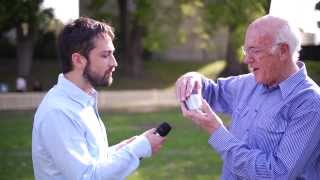
The video explains the states of matter using water as an example, discussing the differences between solid, liquid, and gas in terms of molecular motion and distance. The host interviews people on the street to gather their understanding of the topic before delving into the scientific explanations.
Full Transcript
So, I wanted to talk to people about the different states of matter, solid, liquid, and gas, using water as an example. But I thought first I better be sure that we're all on the same page about what water is made of. What's water made of? Water. Yeah. What makes water? Um, water. Okay. What elements does it take to make water? H2O. So, what does that mean? It is water. What elements? Water and cold. Water plus cold. But what does the H and the O mean? Uh um something and oxygen. Something and oxygen. Hydrogen. There you go. Hydrogen. Hydrogen and oxygen. What's the two mean? Hydrogen. Oxygen. And the two H2O. Why do we say two? Uh I don't know. It's two particles of hydrogen and one of oxygen. There you go. So that that makes what we call a water compound. Two two atoms of hydrogen and one atom of oxygen makes a water molecule. I know the word was like on the tip of your tongue. I guess we got there in the end. So what's the difference between solid and liquid water? Uh so the obviously the temperature of it it's a lot colder. Um ice is frozen. What does it mean to be frozen then? Colds. Liquid water is no good for skating on. Ice is great. Nothing other than temperature. So, everyone recognizes that temperature is important in determining whether the water is ice or liquid. But what's actually happening between the water molecules? What's the difference between water and ice? It's frozen. What does it mean for something to be frozen? It's solid. What does it mean for something to be solid? That it's like a brick. It's like a brick. And what makes it like a brick? What's happening in there? I don't know. But what makes it a solid versus a liquid? Well, in this case, lots of pipes going underneath. But that makes it very cold. Makes it very very cold. Yeah. But what's actually happening to the little bits of water? They're attaching to each other. Are they attach They're attaching. And this is This is all the guess work here. I imagine they're attaching to each other. They're forming a more solid endpiece. You cool liquid water down and then at some point, what happens to it? I don't know. Slows down, freezes, and stops moving. The molecules become frozen. How do they become frozen? They join together. They uh accumulate. They coagulate. Coagulate is not the technical term for it, but everyone was on the right track. In ice, the water molecules are basically fixed in place. They form a crystal lattice where their only motion is vibrating. So, what happens if we heat up the ice? Like, how what happens when like a solid melts? Um, they all bounce out. And what are we talking about? Melt. What? What is they What are they doing? Well, like in science, you draw little circles. What are those little circles? Oxygen. Are they just oxygen? Hydrogen. Oxygen. And the two And the two the temperature is higher. So, so the particles, they're less stable. Yeah. Yeah, less stable. Not stable. Less more free to move around. That sense, right? They become separate and they are allowed to move around. And in gas, maybe they're further apart. Is that Is that what we Okay. Okay. Fantastic. This guy has nailed it. All right. That makes sense. That's awesome. All right. So, in liquid water, the water molecules not only vibrate, they can also rotate and slide past each other. And this is what allows the substance to flow. At even higher temperatures, the water molecules become free of that liquid and turn into water vapor. In that state, they are very very far apart and moving very quickly. So, the major differences between solid, liquid, and gas are the motion of the particles and the distance between them. Of course, you may want to meditate on these differences some more. Oh, what about the difference between a solid, a liquid, and a gas? Oh, that's easy. I teach meditation and it's all about the um as you deexite something so you deexite the mind you get more orderliness as you deexite water vapor you get water as you deexite water you get ice more orderly so in fact the molecular structure becomes more orderly that's the difference that sounds quite reasonable how do you deexite something well in in this case you actually remove energy from it in human beings you calm their minds down with meditation And that works. We get the excited. Yeah. Does that mean if I meditate too much I might turn into ice though? No. But you'll generally become cool. [Laughter] Good answer, sir. Thank you so much.
Original Description
Everyone is familiar with liquid water, ice and water vapour, but what are the differences between these three states of matter? Solids, liquids and vapours of the same substance differ in the motion of the molecules and the distance between them.
Animations courtesy of VisChem (Trade Mark), Copyright 1995, Roy Tasker. Thanks for all your help!
Watch on YouTube ↗
(saves to browser)
Sign in to unlock AI tutor explanation · ⚡30
Playlist
Uploads from Veritasium · Veritasium · 14 of 60
1
 2
2
 3
3
 4
4
 5
5
 6
6
 7
7
 8
8
 9
9
 10
10
 11
11
 12
12
 13
13
 ▶
▶
 15
15
 16
16
 17
17
 18
18
 19
19
 20
20
 21
21
 22
22
 23
23
 24
24
 25
25
 26
26
 27
27
 28
28
 29
29
 30
30
 31
31
 32
32
 33
33
 34
34
 35
35
 36
36
 37
37
 38
38
 39
39
 40
40
 41
41
 42
42
 43
43
 44
44
 45
45
 46
46
 47
47
 48
48
 49
49
 50
50
 51
51
 52
52
 53
53
 54
54
 55
55
 56
56
 57
57
 58
58
 59
59
 60
60
Scientific Notation - Explained!
Veritasium
I'm Atoms (Scientific Cover of Jason Mraz's I'm Yours)
Veritasium
Scientific Notation - Example
Veritasium
What is a Force?
Veritasium
Khan Academy and the Effectiveness of Science Videos
Veritasium
Supercooled Water - Explained!
Veritasium
Galileo the Scientific Parrot
Veritasium
Radiation vs Radioactive Atoms
Veritasium
What Is Electricity? (Are You Gonna Be My Girl?)
Veritasium
Why Is Ice Slippery?
Veritasium
Impress Her With Nanodiamonds
Veritasium
Chain Drop Experiment
Veritasium
What Colour Is Most Attractive?
Veritasium
States of Matter
Veritasium
Slinky Drop Answer
Veritasium
Slinky Drop
Veritasium
Atomic Rant
Veritasium
What Is The Magnus Force?
Veritasium
A Human Being Is A Part Of The Whole
Veritasium
Spinning Tube Trick Explained
Veritasium
Where Do Trees Get Their Mass?
Veritasium
Why Do You Make People Look Stupid?
Veritasium
Gyroscopic Precession
Veritasium
How Does A Slinky Fall?
Veritasium
Spinning Disk Trick Solution
Veritasium
Does a Falling Slinky Defy Gravity?
Veritasium
Northern Lights From 100,000 ft!
Veritasium
The First Meeting of EDUtubers! ft. CGPGrey, Vsauce, Smarter Every Day, Numberphile +more
Veritasium
Free Higgs!
Veritasium
How Can Trees Be Taller Than 10m?
Veritasium
What Now For The Higgs Boson?
Veritasium
How Trees Bend the Laws of Physics
Veritasium
Paralysed Rats Made To Walk Again
Veritasium
What Could Survive An Atomic Bomb?
Veritasium
Heisenberg's Uncertainty Principle Explained
Veritasium
Why Do Venomous Animals Live In Warm Climates?
Veritasium
Veritasium Trailer
Veritasium
What Can Frogs See That We Can't?
Veritasium
World's Roundest Object!
Veritasium
Epic Slow-Mo Drum Implosions!
Veritasium
Empty Space is NOT Empty
Veritasium
Your Mass is NOT From the Higgs Boson
Veritasium
How Does a Transistor Work?
Veritasium
Bullet Block Explained!
Veritasium
How We’re Fooled By Statistics
Veritasium
Facebook Fraud
Veritasium
The Most Common Cognitive Bias
Veritasium
Anti-Gravity Wheel?
Veritasium
Anti-Gravity Wheel Explained
Veritasium
Why Trees Are Taller Than They Need To Be
Veritasium
Misconceptions About the Universe
Veritasium
Why Women Are Stripey
Veritasium
What is NOT Random?
Veritasium
Explained: 5 Fun Physics Phenomena
Veritasium
Climate Change is Boring
Veritasium
13 Misconceptions About Global Warming
Veritasium
CapitolTV's DISTRICT VOICES - District 5: Electric Sparks From Falling Water
Veritasium
Sparks from Falling Water: Kelvin's Thunderstorm
Veritasium
The Most Persistent Myth
Veritasium
The Most Radioactive Places on Earth
Veritasium
More on: Copywriting Basics
View skill →







Related Reads
📰
📰
📰
📰
Next.js Web App Development: Complete Guide for Fast, Scalable Applications (2026)
Dev.to · Avanexa Technologies
Next.js Quietly Fixed the Prefetch Problem Nobody Wanted to Talk About
Medium · JavaScript
A Fast Request, a Fast Parse and a Slow Page
Medium · JavaScript
Tags, Releases, and Branches: A Practical Guide to Frontend Deployment
Medium · Programming
🎓
Tutor Explanation

 DeepCamp AI