Thinking Like an Economist with Prof. Jonathan Gruber (S1:E9)
Skills:
Staying Current in AI50%
Key Takeaways
Teaches economic thinking with Prof. Jonathan Gruber
Full Transcript
I think the main thing an economics course can do in this day and age is get people be a little more flexible, a little more thoughtful about decisions they make and seeing both sides of the problem. Today on the podcast, seeing economics in a whole new light. I've had application the course about demand and supply about Kim Kardashian tweeting herself out a picture of an exercise corset and that it increased demand for exercise corsets. And so thinking about how something where students can sit and say, "Wow, I hadn't realized that economics helps me think about that problem." Welcome to Chalk Radio, a podcast about inspired teaching at MIT. I'm your host, Sarah Hansen, from MIT Open Courseware. In this episode, we'll be talking about the course 14.01, introductory microeconomics. This course is filled with unique and creative applications for microeconomics in our everyday lives. I'll be chatting today with the creator of this course, Professor John Gruber. One of the things I was most excited to find out was the way people perceive economics. So, I asked Professor Gruber what misconceptions students tend to bring to this class. That's a good question. I think they tend to perceive it as maybe softer than it is, maybe not perceive that you're going to derive fairly sharp tools that are going to help you explain a lot of the world fairly easily. Then, on the other hand, they often come sort of with expectations that we'll explain more of the world than we can. So, how do you help them address these misconceptions? I think by just being honest about the limitations and benefits of our models, by explaining the power that our models can deliver in fairly simple terms and explaining a lot of the world, but at the same time, representing the things the models can't easily explain and being honest about that and trying to get students interested in studying more economics they can explain those things as well. I don't expect most viewers of my videos to go on and get a PhD in economics, unfortunately. I expect they're going to go out and have other jobs, do other things, and I want them to be more educated consumers of goods and to understand what's going on in the world in terms of economic policy. Could we talk a minute about the real-world applications? It's a really interesting part of the course. You have LeBron James' college decision, the Uber surge pricing. Tell us about your decision to really anchor the course with these real-world applications. It's what makes economics fun. I mean, once again, I'm not training people to be economics PhDs here. I'm training people to think like an economist. And thinking like an economist, if you've got a very facile mind and you sort of look at the basic theory videos I teach you, you can understand it. But you only really understand something when you go out in the real world and apply it. And so, it's a chance for people to see the ways that economics rules the world, but to also sort of apply what they learn to make sure they understand it. What tips for educators do you have about selecting really good applications? I think it's just a matter of trying to find examples in the real world that are relatable students, that are companies they've heard of, and issues they think about, and that in a not necessarily obvious way teach you about the lessons you want to learn. You know, I've had application the course about demand and supply about Kim Kardashian tweeting herself out a picture of an exercise corset and that it increased demand for exercise corsets. And so thinking about how something where students can sit and say, "Wow, I hadn't realized that economics helps me think about that problem." Professor Gruber's passion for economics is clear, and I wanted to get to the bottom of it. Why does he care so much about helping others find their passion for economics, and how did his own curiosity begin? I came to MIT knowing that I was good at math, but I didn't really like it. What I liked was real-world social policy types of issues, and I took 14.01 and said, "Oh my god, I can use math to apply to the real world. Isn't this cool?" And I've been sort of hooked ever since. Many of your listeners will not realize that there was a time when we used to talk to people next to us on a plane before we had smartphones. And every time I fly in a plane and tell the person next to me I'm an economics professor, they'd say, "Ugh, that was the worst course I ever took." And I thought, "That can't be true. I mean, it might not be the best, but there's no way it could be the worst course someone ever took." And I realized it just was generally badly taught in our school systems, and so I was always interested in trying to address that. But I think really where I really want to go is figure out a way to write better problems. It's easy to write a problem with a mathematical solution. You know, "The firm has the following production function, solve for their profit maximization." It's harder to write problems that involve math, but also derive intuition. And that's really where I want to go is help students bridge that link between solving an equation, understanding why they're doing it, and what they're learning from it. I just want to talk about that a little bit more because you're not the first MIT faculty member to really want to hone in on intuition. And I'm just wondering like how do we develop students' intuition? Because I'm sure educators out there in all sorts of fields are wanting to do this, too. Is it something that's developed over time in a field and just with experience, or is it something we can cultivate as teachers? I think that it is something we can cultivate. I think that it comes from not assuming people know things they don't know. It comes from teaching in layers, so that if there's a set of things I teach that I'd be really disappointed if not everyone came out with the intuition from my class. There's others more subtle concepts that if not everyone remembers them or understands them, then that's not the end of the world. But I'd like students who want to go on to be like, "Ooh, that's interesting. I want to go down that path." So, I think it's really about getting the things that are really you really want people to know, hammering them. But the other thing I like that I do in my class is really always have a constant road map. I always tell the students, "Okay, here's where you came from, here's where we're going, here's where it fits in." So, they can sort of have a holistic sense of how it all fits together. In our conversation, I asked Professor Gruber what he believes educators can do practically to transfer problems from the classroom into the real world. And his answer touched on a point that is coming into play all over our modern world, the complexity and truth about, well, truth. I think the main number one thing is just to teach a healthy respect for the scientific method, to teach students that there are objective truths and that there's this long-standing scientific method for how we get at them. The other thing, however, is to recognize that there are two sides of almost every issue. And that this is something that a lot of students at MIT sometimes have problems with my class, which is it's not just an equation with one right answer. There's pros and cons to a lot of these things. So, I think it's teaching a search for the objective truth that can help you come to the conclusion that works for you. That there's not necessarily one right answer. You and I might disagree about a topic, but we should agree on objective set of facts and have a scientific method for getting to our conclusion. I think that's the key in the today's world, especially. That's the key. It's just getting people to have a healthy disagreement rather than unhealthy disagreement. One of the most compelling parts of this course is how it emphasizes ways to carry its concepts forward into the real world. Students are given specific pathways they might follow in their career or lives outside of school where they can use these concepts. This was something really important to Professor Gruber, and I wanted to know why. I feel that economics is enormously powerful. I'm what you might call an imperialistic economist. I feel like economics can explain lots of things in the world, and there's very few situations where a good economic framework can't help you at least go forward in thinking about it. And I don't want students to just take the AP test and forget about it. Quite frankly, I want this to be something they bring with them and actually keep with them. You know, there's a famous old Saturday Night Live skit about what you remember 5 years after college, and it's 5 minutes, and 3 and 1/2 minutes of it spring break. I want them to try to have a basic set of intuitions that they can understand, can apply to decisions they're going to make about how much to save in their 401k, to how hard to work, to what car to choose, to how to buy a house, etc. And quite frankly, to me personally, to how to vote and think about public policy, a set of tools that they can bring to bear on thinking about these important problems in America today. One slight difficulty we have is a lot of students come in much too determined and set in their ways in what they're going to do. I'm going to be an engineer. I'm going to be a computer scientist. And they're they're often not flexible enough. So, part of I view my job, and a lot of times when they're taking economics, they're taking it because they have to. And my job is to get them to say, "Hey, I actually like this." And I love nothing more when I get an email from a student saying, "Wow, I wasn't even going to study economics, but I like your course. Now I want to major in economics." That was wonderful. But I also want the students that's not going to major in economics to several years later saying, "Hey, yeah, that's something I can relate what I learned in economics to how I think about that problem, and that could help me in my life." Microeconomics is basically economics. Macroeconomics is essentially applied micro. It it's basically it's about everything every decision we make, every decision firms make can all be informed by economic framework, and they can be informed in a particularly healthy way today because the economic framework really is about tradeoffs and about thinking the fact that nothing's easy. Everything involves pros and cons and tradeoffs, and there's shades of gray to every decision we make. And I think the main thing an economics course can do in this day and age is get people be a little more flexible, a little more thoughtful about decisions they make, and seeing both sides of the problem. If you're interested in learning more about microeconomics or viewing his real-world application videos, you can visit Professor Gruber's interactive online MITx course on edX. To access his full lecture videos from his on-campus teaching, head over to his scholar course on our site at ocw.mit.edu. You'll also find 20 plus additional courses just on microeconomics on OCW. If you're an instructor, head on over to the OCW Educator Portal at ocw.mit.edu/educator to find resources just for you. Thanks for listening. Until next time, I'm Sarah Hansen from MIT Open Courseware.
Original Description
MIT Chalk Radio, Season 1
Instructor: Jonathan Gruber, Sarah Hansen
Subscribe here → https://chalk-radio.simplecast.com/
YouTube Playlist: https://www.youtube.com/playlist?list=PLUl4u3cNGP63YwKIMA9K08FFvdeBEl6Lo
Professor Jonathan Gruber wants to train students to think like economists. Economics uses elegant mathematical models to explain how people make decisions and allocate their resources—but all too often those models are taught in ways that remain disconnected from students’ own experience. In this episode, Professor Gruber shares his thoughts on bridging that gap in his course 14.01 Introductory Microeconomics. He says he tries to anchor the course with real-world examples; as he explains, “You only really understand something when you go out in the real world and apply it.” And those examples, he says, have to be relatable. So rather than discussing companies none of his students have heard of or commodities nobody cares about, he illustrates fundamental economic concepts with examples like Kim Kardashian’s exercise corset, Uber’s policy of surge pricing, and LeBron James’s decision not to attend college. By engaging students with accessible examples of economic principles in action, Professor Gruber helps them develop economic intuition—a sense of how the mathematical models apply in the real, seemingly chaotic world. If you’ve always thought economics was boring, listen in on this podcast. It may change your mind!
Relevant Resources:
MIT OpenCourseWare
https://ocw.mit.edu/index.htm?utm_source=simplecast&utm_medium=shownotes&utm_campaign=chalkradio&utm_term=s1e9
The OCW Educator Portal
https://ocw.mit.edu/educator/?utm_source=simplecast&utm_medium=shownotes&utm_campaign=chalkradio&utm_term=s1e9
Professor Gruber’s Scholar course on OCW
https://ocw.mit.edu/courses/economics/14-01sc-principles-of-microeconomics-fall-2011/?utm_source=simplecast&utm_medium=shownotes&utm_campaign=chalkradio&utm_term=s1e9
Professor Gruber’s microeconomics course on EdX
http
Watch on YouTube ↗
(saves to browser)
Sign in to unlock AI tutor explanation · ⚡30
Playlist
Uploads from MIT OpenCourseWare · MIT OpenCourseWare · 37 of 60
1
 2
2
 3
3
 4
4
 5
5
 6
6
 7
7
 8
8
 9
9
 10
10
 11
11
 12
12
 13
13
 14
14
 15
15
 16
16
 17
17
 18
18
 19
19
 20
20
 21
21
 22
22
 23
23
 24
24
 25
25
 26
26
 27
27
 28
28
 29
29
 30
30
 31
31
 32
32
 33
33
 34
34
 35
35
 36
36
 ▶
▶
 38
38
 39
39
 40
40
 41
41
 42
42
 43
43
 44
44
 45
45
 46
46
 47
47
 48
48
 49
49
 50
50
 51
51
 52
52
 53
53
 54
54
 55
55
 56
56
 57
57
 58
58
 59
59
 60
60

21. Post Trade Clearing, Settlement & Processing
MIT OpenCourseWare
10. Financial System Challenges & Opportunities
MIT OpenCourseWare
7. Technical Challenges
MIT OpenCourseWare
3. Blockchain Basics & Cryptography
MIT OpenCourseWare
19. Primary Markets, ICOs & Venture Capital, Part 1
MIT OpenCourseWare
1. Introduction for 15.S12 Blockchain and Money, Fall 2018
MIT OpenCourseWare
Chalk Radio, A Podcast about Inspired Teaching at MIT (Teaser)
MIT OpenCourseWare
Nuclear Gets Personal with Prof. Michael Short (S1:E1)
MIT OpenCourseWare
How Africa Has Been Made to Mean with Prof. Amah Edoh (S1:E2)
MIT OpenCourseWare
Making Deep Learning Human with Prof. Gilbert Strang (S1:E3)
MIT OpenCourseWare
Social Impact at Scale, One Project at a Time with Dr. Anjali Sastry (S1:E4)
MIT OpenCourseWare
Film is for Everyone with Prof. David Thorburn (S1:E5)
MIT OpenCourseWare
Lecture 12: Aircraft Performance
MIT OpenCourseWare
Lecture 3: Learning to Fly
MIT OpenCourseWare
Lecture 13: Interpreting Weather Data
MIT OpenCourseWare
Lecture 21: Weather Minimums and Final Tips
MIT OpenCourseWare
Hand-on, Minds On with Dr. Christopher Terman (S1:E6)
MIT OpenCourseWare
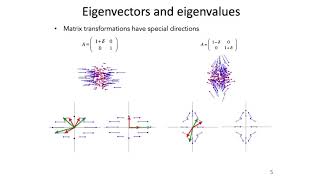
Part 4: Eigenvalues and Eigenvectors
MIT OpenCourseWare
Part 5: Singular Values and Singular Vectors
MIT OpenCourseWare
Part 3: Orthogonal Vectors
MIT OpenCourseWare
Part 2: The Big Picture of Linear Algebra
MIT OpenCourseWare
Part 1: The Column Space of a Matrix
MIT OpenCourseWare
Intro: A New Way to Start Linear Algebra
MIT OpenCourseWare
9. Chromatin Remodeling and Splicing
MIT OpenCourseWare
28. Visualizing Life - Fluorescent Proteins
MIT OpenCourseWare
20. Roth's theorem III: polynomial method and arithmetic regularity
MIT OpenCourseWare
8. Szemerédi's graph regularity lemma III: further applications
MIT OpenCourseWare
19. Roth's theorem II: Fourier analytic proof in the integers
MIT OpenCourseWare
12. Pseudorandom graphs II: second eigenvalue
MIT OpenCourseWare
1. A bridge between graph theory and additive combinatorics
MIT OpenCourseWare
Special Episode: Teaching Remotely During Covid-19 with Prof. Justin Reich
MIT OpenCourseWare
Spring 2020 Update from Dean Rajagopal
MIT OpenCourseWare
S1E7: Unpacking Misconceptions about Language & Identities with Prof. Michel DeGraff
MIT OpenCourseWare
Climate 101 Live
MIT OpenCourseWare
Welcome for Volunteers (for EarthDNA's Climate 101)
MIT OpenCourseWare
Learning to Fly with Drs. Philip Greenspun & Tina Srivastava (S1:E8)
MIT OpenCourseWare
Thinking Like an Economist with Prof. Jonathan Gruber (S1:E9)
MIT OpenCourseWare
2. Cyber Network Data Processing; AI Data Architecture
MIT OpenCourseWare
1. Artificial Intelligence and Machine Learning
MIT OpenCourseWare
2: Resistor Capacitor Circuit and Nernst Potential - Intro to Neural Computation
MIT OpenCourseWare
14: Rate Models and Perceptrons - Intro to Neural Computation
MIT OpenCourseWare
4: Hodgkin-Huxley Model Part 1 - Intro to Neural Computation
MIT OpenCourseWare
18: Recurrent Networks - Intro to Neural Computation
MIT OpenCourseWare
3: Resistor Capacitor Neuron Model - Intro to Neural Computation
MIT OpenCourseWare
15: Matrix Operations - Intro to Neural Computation
MIT OpenCourseWare
13: Spectral Analysis Part 3 - Intro to Neural Computation
MIT OpenCourseWare
16: Basis Sets - Intro to Neural Computation
MIT OpenCourseWare
20: Hopfield Networks - Intro to Neural Computation
MIT OpenCourseWare
8: Spike Trains - Intro to Neural Computation
MIT OpenCourseWare
7: Synapses - Intro to Neural Computation
MIT OpenCourseWare
19: Neural Integrators - Intro to Neural Computation
MIT OpenCourseWare
5: Hodgkin-Huxley Model Part 2 - Intro to Neural Computation
MIT OpenCourseWare
6: Dendrites - Intro to Neural Computation
MIT OpenCourseWare
17: Principal Components Analysis_ - Intro to Neural Computation
MIT OpenCourseWare
12: Spectral Analysis Part 2 - Intro to Neural Computation
MIT OpenCourseWare
11: Spectral Analysis Part 1 - Intro to Neural Computation
MIT OpenCourseWare
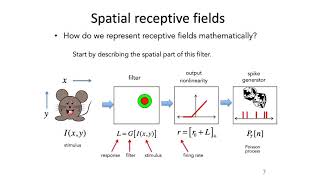
9: Receptive Fields - Intro to Neural Computation
MIT OpenCourseWare
10: Time Series - Intro to Neural Computation
MIT OpenCourseWare
1: Course Overview and Ionic Currents - Intro to Neural Computation
MIT OpenCourseWare
The Power of OER with Profs. Mary Rowe and Elizabeth Siler (S1:E10)
MIT OpenCourseWare
More on: Staying Current in AI
View skill →






🎓
Tutor Explanation
 DeepCamp AI