5 Rate Limiting Strategies Explained | Protect Your System at Scale
Key Takeaways
This video explains rate limiting strategies, including five techniques for protecting distributed systems at scale
Full Transcript
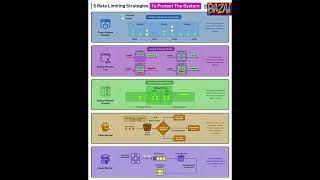
Welcome back to VIA. Today [music] we're breaking down five rate limiting strategies used to protect large-scale systems. These techniques are fundamental for preventing abuse, handling traffic spikes, and keeping services stable under load. Let's walk through them one by one. The first strategy is the fixed window counter. This approach divides time into fixed intervals like 1 minute. For each window, the system counts how many requests a client makes. Once the limit is reached, additional requests are dropped until the next window starts. It's simple and efficient, but it has a major weakness. Traffic spikes at window boundaries can allow more requests than intended, creating burstiness. The second strategy is the sliding window log. Instead of fixed buckets, the system stores exact timestamp of every request. For each new request, it checks how many requests occurred within the last time window. This gives very accurate rate limiting and smooths traffic but comes at a cost. Storing and scanning time stamps consumes memory and CPU making it expensive at high scale. The third strategy is the sliding window counter. This is a hybrid approach. It divides time into small windows and calculates a weighted sum of the current and previous window. This smooths out spikes better than fixed windows while using far less memory than sliding logs. It's a practical balance and is commonly used in real world systems. The fourth strategy is the token bucket. Here, tokens are added to a bucket at a steady rate. Each incoming request consumes one token. If tokens are available, the request is allowed. If not, it's dropped or delayed. The key advantage is flexibility. Token buckets allow short bursts while still enforcing an average rate limit, which makes them ideal for APIs. The fifth strategy is the leaky bucket. Incoming requests are placed into a queue and processed at a fixed rate like water leaking from a bucket. This smooths traffic perfectly and protects downstream systems, but it can introduce latency. If a queue fills up, requests are dropped. So, how do you choose? Fixed windows are simple but imprecise. Sliding logs are accurate but expensive. Sliding counters offer a good balance. Token buckets are best for APIs that need burst tolerance. Leaky buckets are great when you want strict smoothing and predictable processing rates. In real systems, rate limiting is often combined with API gateways, load balancers, and circuit breakers to form a complete protection layer. The key takeaway is this. Rate limiting is not just about blocking requests. It's about protecting system health while delivering a consistent user experience. That's how production systems stay reliable under pressure. Follow Bazai for more deep dives into real world system design and back-end architecture.
Original Description
Rate limiting is one of the most important techniques for protecting modern distributed systems.
In this video, we break down five rate limiting strategies used in real-world systems to prevent abuse, absorb traffic spikes, and keep services reliable under load.
You’ll learn:
Fixed Window Counter
Sliding Window Log
Sliding Window Counter
Token Bucket
Leaky Bucket
We explain how each strategy works, their trade-offs, and when to use them in production systems like APIs, microservices, and cloud platforms.
This video is ideal for:
Backend engineers
System design interview preparation
Platform and infrastructure engineers
Developers building scalable APIs
Subscribe to Bazai for deep, practical system design and architecture breakdowns.
Watch on YouTube ↗
(saves to browser)
Sign in to unlock AI tutor explanation · ⚡30
Playlist
Playlist UUOthur5d9OxdqEh08Swtirw · BazAI · 36 of 49
1
 2
2
 3
3
 4
4
 5
5
 6
6
 7
7
 8
8
 9
9
 10
10
 11
11
 12
12
 13
13
 14
14
 15
15
 16
16
 17
17
 18
18
 19
19
 20
20
 21
21
 22
22
 23
23
 24
24
 25
25
 26
26
 27
27
 28
28
 29
29
 30
30
 31
31
 32
32
 33
33
 34
34
 35
35
 ▶
▶
 37
37
 38
38
 39
39
 40
40
 41
41
 42
42
 43
43
 44
44
 45
45
 46
46
 47
47
 48
48
 49
49
How LLM Agents Actually Do Deep Research (Planning, Tools & Citations Explained
BazAI
Kafka vs RabbitMQ Explained: Which One Should You Use?
BazAI
#NOVER Explained: How AI Learns to Judge Its Own Reasoning (No Reward Model Needed)
BazAI
The State of Enterprise AI 2025: How Workers Save 60 Minutes Daily & Adoption Explodes 9X
BazAI
NVIDIA Nemotron 3: 1M Context, Hybrid MoE Architecture, and Open Source AI Agents
BazAI
How Service Mesh Works: Data Plane, Control Plane & Observability
BazAI
How to Design Safe Retries in Microservices (No Duplicates, No Overload)
BazAI
Step-GUI: The Self-Evolving AI Agent for Android & PC (SOTA Performance!)
BazAI
NVIDIA's NitroGen: The First Generalist AI Trained to Play 1,000+ Games by Watching
BazAI
How AI Agents Remember: The Evolution of Agentic Memory (2025 Guide)
BazAI
Automate Your AI Data Pipelines: Introducing DataFlow & DataFlow-Agent
BazAI
Nemotron 3 Explained: Hybrid Mamba + MoE for 1M Token Agents
BazAI
Build Your Own AI Voice Agent (LangChain + OpenAI + AssemblyAI + Cartesia)
BazAI
Langflow 1.7 Explained: CUGA, ALTK, MCP & the Death of Prompt Engineering
BazAI
HuatuoGPT-o1: The First Medical AI That "Thinks" Before It Answers
BazAI
Molmo2: Open-Source Vision-Language Models with State-of-the-Art Video Grounding
BazAI
MAI-UI: Alibaba’s New Foundation GUI Agents Outperforming Gemini & GPT-4o
BazAI
Seamless AI Object Insertion: Bridging 4D Geometry and Diffusion Models
BazAI
5 AI Agentic Workflow Patterns-Reflection, Tools, ReAct, Planning, Multi‑Agent
BazAI
#NVIDIA's New #SurgWorld: How AI is Learning Autonomous Surgery
BazAI
CQRS Explained in 3 Minutes: How Modern Systems Scale Reads vs Writes
BazAI
Docker Explained in 3 Minutes: How Containers Actually Work
BazAI
6 Practical AWS Lambda Patterns in 3 Minutes (Real‑World Serverless Guide)
BazAI
Containerization Explained in 3 Minutes: From Dockerfile to Running Containers
BazAI
Science Context Protocol (SCP)- Global Web of Autonomous Scientific Agents
BazAI
Youtu-Agent: Scaling LLM Agent Productivity via Automated Generation and Hybrid RL
BazAI
#DeepSeek’s #mHC Breakthrough: Stabilizing Hyper-Connections for Large-Scale LLM Training
BazAI
Message Brokers 101 in 3 Minutes: Queues, Pub‑Sub & Competing Consumers Explained
BazAI
Must‑Know Message Broker Patterns: Outbox, CQRS, Saga & More
BazAI
Confucius Code Agent-Scalable Scaffolding for Large-Scale Repositories
BazAI
#nvidia Just Fixed #GRPO! Meet #GDPO: The New Standard for Multi-Reward RL
BazAI
NVIDIA Alpamayo-R1: Real-Time Reasoning for Level 4 Autonomy
BazAI
The Future of AI Memory: Meet #AtomMem’s Learnable CRUD System
BazAI
Database Sharding Explained | Range vs Hash vs Directory Sharding
BazAI
12 Architecture Concepts Every Developer Must Know | System Design Explained
BazAI
5 Rate Limiting Strategies Explained | Protect Your System at Scale
BazAI
How Live Streaming Works | System Design Explained
BazAI
5 Leader Election Algorithms Explained | Distributed Systems & Databases
BazAI
6 Prompting Techniques to Get Better Results from ChatGPT
BazAI
Complete Guide to Storage Systems: RAM, SSD, SAN, Cloud & Databases
BazAI
Top 4 Authentication Mechanisms Explained | SSH, OAuth, SSL & Passwords
BazAI
Common Network Protocols Explained | TCP, UDP, HTTP, DNS & More
BazAI
Microservices Best Practices | 9 Rules Every Architect Must Know
BazAI
8 Network Protocols Every Engineer Must Know | HTTP, TCP, UDP & More
BazAI
Distributed Systems in 3 Minutes: CDNs, APIs, TCP & Idempotency Explained
BazAI
Must‑Know Message Broker Patterns in 3 Minutes (Outbox, CQRS, Saga & More)
BazAI
Is OpenClaw Safe? The "Security Nightmare" Behind the Viral AI Agent
BazAI
JWT vs Sessions vs PASETO — Which Authentication Should You Use?
BazAI
Recursive LLMs vs Big Context Windows: Why RLM Wins
BazAI
Related Reads
📰
📰
📰
📰
Fairness and Backpressure in Real-Time Moderation Queues
Dev.to · Gathmo
Designing Upload Expiration as a Recoverable State
Dev.to · Gathmo
Go vs C: Exploring Solod's Case for Replacing C in Systems Programming
Dev.to · Tamiz Uddin
Which Vendors Specialize in SECS GEM Connectivity for Factory Automation?
Dev.to AI
🎓
Tutor Explanation

 DeepCamp AI