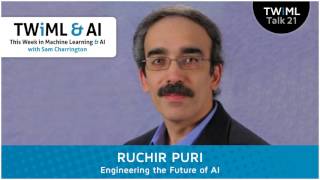
Engineering the Future of AI with Ruchir Puri - #21
Key Takeaways
Interview with Ruchir Puri on engineering the future of AI for businesses
Full Transcript
[Music] hello and welcome to another episode of twiml talk the podcast where I interview interesting people doing interesting things in machine learning and artificial intelligence I'm your host Sam charington how many of you remember my conversation with Josh Bloom from twiml Talk number five Josh is the founder and CTO of startup wise. which sought to apply AI to the challenge of providing customer support in Josh's words what we do in our company at WISE is help customer support agents uh become more efficient at their work uh by suggesting answers of how they can respond to an incoming inquiry uh by automatically triaging um uh incoming increase or or emails Etc uh that is getting them to the right person or the right group who's going to be the best at answering that question and then in some cases uh we will automatically respond to incoming inquiries so when you write into uh e-commerce site and say my package didn't arrive there's a growing chance that us or somebody else U may be answering what looks like a bespoke uh question of yours with a what looks like a bespoke uh answer Josh shared a ton of insight into how to build AI powered products in that show including gems like this one yeah so there's definitely this separation of concerns uh which again is both uh uh an organizational one and then is also a computational one um to the level where we think we often talk about what we call the organizational API of who within this stack is the customer of who um and so for instance the people who are the sort of core um ML and algorithms folks in the company are working in C++ and surfacing the great results back in into a python layer um their customer is the data science team uh the customer of the data science team um is the uh the people working on our architecture who have to make maintain uh you know this this scalable robust infrastructure um and you know their customers are the people working in the middleware and their customers are the ones in the in the in the UI um and so each of them have a a a set of contracts of what it is that each part of that stack is looking for and um and how in fact they're supposed to engage with each other um having the data science team be able to push stuff into production without having to be on the op side of things nor have to think about the architecture uh has a has really freed us up um in great ways I think to innovate since my conversation with Josh he sold wise. iio to GE and now he's working to quote unquote AI all the things at that massive company so why the trip down memory lane well it's because Josh is just one of the many great speakers who will be joining me at the future of data Summit May 15th and 16th at the interop ITX conference in Las Vegas Josh will be there to elaborate on his experience building AI products and Platforms in what will surely be an amazing presentation a few other speakers I've recently added to the agenda include Zachary hanif who's part of a SWAT team of sorts at Capital One that helps various parts of the business incorporate machine learning and AI into their projects Shri Canon ramachandran who will be joining us to talk about Marketing in the age of AI and how her team uses machine learning to drive Topline growth at Telecom giant level three communications Shri is a big fan of the podcast and I'm really looking forward to her talk and Jennifer pranky who leads data science and data strategy teams at Walmart Labs she'll be speaking on the challenges of integrating data from multiple silos to support machine learning and AI applications from multi Channel retail and after their presentations I'll be leading a Q&A and panel discussion with the three of them on bringing AI to the Enterprise this will be the time to get your questions answered now the future of data Summit is approaching quickly but it's not too late for you to join me to register for the summit using my 20% off discount code visit twiml a.com interop of course if you have any questions about the summit feel free to reach out to me via the contact page on twiml ai.com okay now let's get to Today's Show today we bring you the second of three interviews we did backstage from the NYU future Labs AI Summit this time with rasher Puri rasher is an IBM fellow and the Chief Architect at IBM Watson I caught up with rasher after his talk on engineering the future of AI for business our conversation focused on cognition and reasoning and we explored what these Concepts represent how Enterprises really want to consume them and how IBM Watson seeks to deliver them enjoy the show all right everyone so I'm here with rasher Puri uh an IBM fellow and Chief Architect with IBM Watson Rouser just came off from giving his presentation here at the future Labs AI Summit uh welcome rasher thank you uh why don't we start with uh you giving us a little bit of uh a little bit of a view into your background so I have a background pretty much I started at the at the level of all the way down to circuits and physics and over time I've been just traveling that staircase in terms of abstraction levels uh going going up the abstraction level and and I'm you know traveled from circuits to uh systems to algorithms and software uh to Cloud to AI for last 5 years or so and and all along I've I've worked on algorithms for all kind of applications including algorithm for Designing chips to algorithm for Designing systems to making them smarter to now know algorithms for Watson and my job is to make Watson less shiny more real nice nice so that must give you a unique perspective uh because in many ways it seems like AI is starting at that top level of abstraction and then working its way down to the chip level yeah so that that that that's a very interesting point and and I think I I would consider myself lucky to to be able to gather the experience I I have gathered over past two and a half decades or so I would say um where I started actually down and traveled up where interestingly the details at the bottom are quite overwhelming and as you move up you are abstracting things and and as you move down uh people many people shy away from those details so yes it does give you a unique perspective into a common uh systems and and a software and a cloud view into this actually and and by systems I just don't mean a you know a board or or a chip I really mean system in its entirety which is a you know living breathing Cloud so that's great so why don't you tell us a little bit about the presentation you just gave for those who weren't able to attend what did you talk about so I I I gave a talk on um engineering the future of AI and I basically took took the folks through a a journey which is you know what is the what is the art of possible and and if you really do it right where are we today and and I differentiated you know the coolness of AI to what problems we really need to solve where you know the Enterprises are struggling uh where lot of problems need to be solved it's not just about finding cats and dogs it's really about you know Finding you know I have a tax problem you know go go solve it for me right that popular to beat up on tax cats and dogs nowadays yeah so you know that's uh so I took and then I really talked about you know where where the fallacies of some of the current techniques may be and where we really need to go okay so uh what in your perspective is are some of those real Enterprise problems what are folks really trying to accomplish with this technology so I think folks in in in the Enterprise first of all they really are trying to solve problems of um large data in terms of you know I've got massive number of documents uh varying formats of documents um varying modalities of data as well I could have audio data I could have video data I could have uh data available in all kind of different formats from PDFs to uh to docs to everything else actually that's available uh including you know scan jpeg images of of uh you know documents and other things I may be scanning uh go address it for me and then to be able to have what I call conversational Discovery H um I I call that whole domain what what I would say conversational discovery which means what uh don't just discover things for me and I talked about this in the in the presentation I just gave as well um cognition is not just about I ask you a question and then you give me an answer if you knew the answer you gave me an answer that's called search actually uh cognition is more about I ask you a question you actually come back and say oh I've figured out five pieces of that puzzle I don't know five pieces of the puzzle that I really need to answer that question I'm going to summ I that in the form of a question back to you and trying to get the answer out of you so that you can guide me that's really what cognition is about it's not about you know okay how you know above what limit I need to pay what tax yeah it's there in the document it's really about you know finding the pieces of puzzle and posing it back to me in a way and getting a conversation getting me engaged in a conversation so that you can get the answer back that's what I call so Discovery is a is an Enterprise application and then conversational Discovery make it more consumerized actually so it's really about amalgamation of consumers and Enterprises consumer experience with Enterprise problems interesting I like the way you put that conversational Discovery I have been talking to people and asking people about what I call um intelligence uh intelligence design like how do we design experiences in light of artificial intelligence and one thing that strikes me is that it's uh it needs to be at least very interdisciplinary and so when you talk about uh conversational Discovery it makes me think that we've uh accomplished a lot in terms of how do we make uh information and data discoverable interactively uh in the business intelligence world like ad hoc you know quiry Discovery things like that are are you are you at IBM or do you see any place people that are are working to pull all these threads together to make conversational Discovery possible yeah so so we've got actually um a a application um we have a whole bunch of actually um apis available uh to for developers to go and write their applications against Discovery is one of the more fundamental apis we have available so we we classify our our apis into three categories one is conversation based one is Discovery based and the third one is what I call signal actually which is you know speech text all this all this stuff actually uh and and and images is part of it as well and and yes we see we at at Watson have been working very hard towards bringing all these together uh conversation along with speech along with Discovery with reasoning actually as well so it's not about just you know information retrieval it's not information retrieval it's about reasoning also which is where conversational Discovery with natural speech becomes very powerful so that's exactly what we've been working towards um we've got pieces of it already there out in the marketplace uh like Discovery is there in the marketplace and other things we are working towards as we bring more and more reasoning techniques into Discovery and conversation on top of it reasoning is a very high level concept how do you make that more concrete for people what actually are you doing uh that you classify as reasoning so I I'll I'll let let me let me give an uh give an example of of of reasoning actually so obviously for for academic folks there are three kinds of reasoning abductive inductive and you know I'm not going to bore you with that that nomenclature but but let's assume for the time being actually um that that you're trying to um f again I I I'm going to go go back to the example I gave I got five pieces of the puzzle figuring out there are 10 pieces of the puzzle itself is reasoning right you asked me a question figuring out 10 pieces of the puzzle itself is reasoning figuring out I've got five of them figured out that's another level of reasoning and then combining the five unknowns into a a summarization and posing that question back is actually part of summarization not necessarily reasoning and then when you pose a question back to me going and figuring out that those satis why that five pieces are not the answer you gave back to me that is reasoning as well actually okay um and then there is obviously you know mathematical reasoning that we can have right as well so uh so as you so you're primarily delivering uh Watson via apis presumably this reasoning uh element as well what does the API look like you not just have some Corpus of data and say okay go reason and tell me back things you're are you directing it what is what's the so reasoning is really built as as part of many of the apis internally itself um so for example you know Discovery and and and Knowledge Graph as we move forward and uh querying on knowledge graphs and reasoning on knowledge graphs as well is delivered as as part of the capability of Discovery so it's not that we are exposing reasoning in its abstract form it's integrated as part of the apis that we are delivering uh specifically in Discovery specifically in things like uh compare and comply I showed examples of obligations and controls uh that's reasoning itself as well uh figuring out what are my obligations may not be uh be be reasoning however figuring out what obligations and what what controls map with each other is actually certainly form of reasoning as well so these are all integrated together and we are bringing it out as you know very consumable apis which underneath actually use many reasoning techniques as we move forward okay and do you think uh reasoning as a service is a is a worthwhile goal is that separate and distinct in your mind from uh AGI uh as it maybe an intermediate step even or is that not really the the direction you're headed so so at least in terms of so certainly and I'm I'm going to take just a step back just for a minute and and and we we are working towards bringing out learning as a service actually MH so whether it is deep learning or machine learning Watson machine learning is already available actually on our on our apis so learning as a service and it's it's certainly I could argue certainly we are watching the consumer Behavior very very closely actually however um it really will depend on it's hard for me to see right now whether somebody will consume reasoning in abstraction it's very hard to figure out actually and and it's it's really hard for me to pinpoint that if that is what will that be reason in abstraction so I I would say currently know however you know this area is evolving very fast and we are keeping our mind open with respect to if something's emerged um people like you know people are actually obviously we are working on uh uh data science workbench as well that we are exposing and part of those algorithms we can expose reasoning algorithms we can expose too so obviously for data scientists we can have capabilities which get exposed directly in terms of hey I want that reasoning algorithm and that reasoning algorithm but to me other than for for you know phds in this area it's hard for me to see how consumers actually uh and by consumers I really mean Enterprise consumers as well how they they just abstractly consum consume reasoning but again it's it's a fast moving area so so if you were to to um lay out you know one two three General directions for the machine learning as a service apis you know where are they headed what should we expect to see from uh those that that you offer as well as the field as a whole so so machine learning as a service specifically so many things that are available in in the marketplace today is what I call Amis actually you know you can go to Amazon or or Google and you can download something and you know you can spin up a VM and go install it and play to your heart's content however to me where things are really headed is you bring me your data mhm you don't have to tell me whether you want to to choose cafe or tensorflow or you know bring me your data by the way data is gold right in this area data is gold if I gave you my data I gave you my life effectively and I've given you my life already you guide me regarding don't ask me what neural network you want I don't know the head and tail of neural network as a consumer neither do I want to know I run my business don't ask me what kind of neural network would you like you would you like 2 gpus or 4 gpus say what do I care go go figure it out and so it really is heading for what I would call machine learning for machine learning MH go figure out on top of machine learning a entire layer which is smart enough which takes data right and then you know figures everything out and gives me that Insight back that's where things are heading don't ask me do you want to use logistic regression or naive Bas do I care really right I say huh what did you ask me that's where things are heading which is more on AI for AI or machine learning for machine learning because the the you know the lower layer can get complex actually and should not be exposing that to the to the end consumers obviously there is you know a narrow percentage of people let's say 5% or so who are phds in deep in either deep learning or data science area who do want to actually Tinker with that but majority of the people um they really don't want to they want to actually give you the data and really get insights out of it you need to make it seamless for them you don't even need to tell them you know I've got gpus yeah so if it helps them go use it if it doesn't don't use it actually are you getting any push back in fact uh from people who don't want to give you the data actually certainly as I as I described we've got three levels of of data sources actually I would say and where we are enriching that data and deriving insights out of that public domain private MH and we seamlessly sort of weave across that public being I already talked about which is you know Wikipedia kind of data domain being you are in finance industry or insurance industry you got knowledge based for that and then private is your data right uh which we don't share with anybody neither do we share the insights of that with anybody as well and uh as we explain in fact one of our strengths at IBM Watson is really are are specifically this Clarity on data we will not use your data specifically to go and benefit others your data your data you hold the insights for that and and our CEO and and David Kenny who's the the senior VP of Watson has been very explicit in saying this so I would say one of our our differentiators actually at at Watson is specifically the clarity of the data policy and specifically the the we weaving across this seamlessly with Watson okay great uh so to wrap things up do you have maybe three takeaways from your presentation that you uh would like to leave folks with or was was there were there any um calls to action that you laid out so I would really say you know first of all these are really interesting times the you know AI has made tremendous progress in in last you know decade or so more recently in Last 5 Years and and businesses are hungry for how to really consume this this wave of of break throughs that we've been actually getting um the the problem is really not about uh obviously being able to search but be able to reason over the data as well build models and make it easy to consume actually and to get to the next level of cognition which I call actually conversational Discovery with with reasoning or interaction with inside there are many names of it but really I think from a it's very interesting times for business buiness businesses because at the lower layers the complexity is quite large you need to be able to to abstract that complexity from the users and be able to give them insights they are giving you the data and and that's all they need to give you you should actually you know really insulate this from them and be able to give them the the benefit of of conversational Discovery as we move forward so great well great thank you very much for being on the show it was uh great to meet you and um to get your perspectives on these things thank you thank you all right everyone that's our show for today once again thanks so much for listening and for your continued support don't forget to share your favorite quote from this show via the show notes page Twitter or our Facebook page if you do we'll be happy to send you one of our great laptop stickers the notes for today's show will be up on twiml ai.com talk21 where you'll find links to rasher and the various resources we mentioned and finally please be sure to check out the future of data Summit the updated agenda is posted at twim ai.com futureof dat and you can visit twiml ai.com interop for more information about registering thanks so much for listening and catch you next time e e
Original Description
Today we bring you the second of three interviews we did backstage from the NYU FutureLabs AI Summit, this time with Ruchir Puri. Ruchir is the Chief Architect at IBM Watson as well as an IBM Fellow. I caught up with Ruchir after his talk on “engineering the Future of AI for Businesses”. Our conversation focused on cognition and reasoning, and we explored what these concepts represent, how enterprises really want to consume them, and how IBM Watson seeks to deliver them.
The show notes can be found at twimlai.com/talk/21.
Subscribe!
iTunes ➙ https://itunes.apple.com/us/podcast/this-week-in-machine-learning/id1116303051?mt=2
Soundcloud ➙ https://soundcloud.com/twiml
Google Play ➙ http://bit.ly/2lrWlJZ
Stitcher ➙ http://www.stitcher.com/s?fid=92079&refid=stpr
RSS ➙ https://twimlai.com/feed
Lets Connect!
Twimlai.com ➙ https://twimlai.com/contact
Twitter ➙ https://twitter.com/twimlai
Facebook ➙ https://Facebook.com/Twimlai
Medium ➙ https://medium.com/this-week-in-machine-learning-ai
Watch on YouTube ↗
(saves to browser)
Sign in to unlock AI tutor explanation · ⚡30
Playlist
Uploads from The TWIML AI Podcast with Sam Charrington · The TWIML AI Podcast with Sam Charrington · 25 of 60
1
 2
2
 3
3
 4
4
 5
5
 6
6
 7
7
 8
8
 9
9
 10
10
 11
11
 12
12
 13
13
 14
14
 15
15
 16
16
 17
17
 18
18
 19
19
 20
20
 21
21
 22
22
 23
23
 24
24
 ▶
▶
 26
26
 27
27
 28
28
 29
29
 30
30
 31
31
 32
32
 33
33
 34
34
 35
35
 36
36
 37
37
 38
38
 39
39
 40
40
 41
41
 42
42
 43
43
 44
44
 45
45
 46
46
 47
47
 48
48
 49
49
 50
50
 51
51
 52
52
 53
53
 54
54
 55
55
 56
56
 57
57
 58
58
 59
59
 60
60

Engineering Practical Machine Learning Systems with Xavier Amatriain - #3
The TWIML AI Podcast with Sam Charrington
How to Build Confidence as an ML Developer with Siraj Raval - #2
The TWIML AI Podcast with Sam Charrington
Open Source Data Science Masters, Hybrid AI, Algorithmic Ethics & More with Clare Corthell - #1
The TWIML AI Podcast with Sam Charrington
Interactive AI, Plus Improving ML Education with Charles Isbell - #4
The TWIML AI Podcast with Sam Charrington
Machine Learning for the Stars & Productizing AI with Joshua Bloom - #5
The TWIML AI Podcast with Sam Charrington
Generating Labeled Training Data for Your ML/AI Models with Angie Hugeback - #6
The TWIML AI Podcast with Sam Charrington
Explaining the Predictions of Machine Learning Models with Carlos Guestrin - #7
The TWIML AI Podcast with Sam Charrington
Deep Learning: Modular in Theory, Inflexible in Practice with Diogo Almeida - #8
The TWIML AI Podcast with Sam Charrington
Emotional AI: Teaching Computers Empathy with Pascale Fung - #9
The TWIML AI Podcast with Sam Charrington
Statistics vs Semantics for Natural Language Processing with Francisco Webber - #10
The TWIML AI Podcast with Sam Charrington
Building AI Products with Hilary Mason - #11
The TWIML AI Podcast with Sam Charrington
Reprogramming the Human Genome with AI, w/ Brendan Frey - #12
The TWIML AI Podcast with Sam Charrington
Understanding Deep Neural Networks with Dr. James McCaffery - #13
The TWIML AI Podcast with Sam Charrington
Scaling Deep Learning: Systems Challenges & More with Shubho Sengupta - #14
The TWIML AI Podcast with Sam Charrington
Domain Knowledge in Machine Learning Models for Sustainability with Stefano Ermon - #15
The TWIML AI Podcast with Sam Charrington
Machine Learning in Cybersecurity with Evan Wright - #16
The TWIML AI Podcast with Sam Charrington
Interactive Machine Learning Systems with Alekh Agarwal - #17
The TWIML AI Podcast with Sam Charrington
Location-Based Intelligence for Smarter Marketing with Klustera - #18
The TWIML AI Podcast with Sam Charrington
AI-Powered Customer Support with HelloVera - #18
The TWIML AI Podcast with Sam Charrington
Using AI to Simplify the Programming of Robots with Cambrian Intelligence - #18
The TWIML AI Podcast with Sam Charrington
Increasing Efficiency of Healthcare Insurance Billing with NLP, w/ Behold.ai - #18
The TWIML AI Podcast with Sam Charrington
Creating a Worldwide Financial Knowledge Graph with AlphaVertex - #18
The TWIML AI Podcast with Sam Charrington
From Particle Physics to Audio AI with Scott Stephenson - #19
The TWIML AI Podcast with Sam Charrington
Selling AI to the Enterprise with Kathryn Hume - #20
The TWIML AI Podcast with Sam Charrington
Engineering the Future of AI with Ruchir Puri - #21
The TWIML AI Podcast with Sam Charrington
Deep Neural Nets for Visual Recognition with Matt Zeiler - #22
The TWIML AI Podcast with Sam Charrington
Introducing Psycholinguistics into AI with Dominique Simmons- #23
The TWIML AI Podcast with Sam Charrington
Reinforcement Learning: The Next Frontier of Gaming with Danny Lange - #24
The TWIML AI Podcast with Sam Charrington
Offensive vs Defensive Data Science with Deep Varma - #25
The TWIML AI Podcast with Sam Charrington
Global AI Trends with Ben Lorica - #26
The TWIML AI Podcast with Sam Charrington
Intelligent Autonomous Robots with Ilia Baranov - #27
The TWIML AI Podcast with Sam Charrington
Reinforcement Learning Deep Dive with Pieter Abbeel - #28
The TWIML AI Podcast with Sam Charrington
Robotic Perception and Control with Chelsea Finn - #29
The TWIML AI Podcast with Sam Charrington
Natural Language Understanding for Amazon Alexa with Zornitsa Kozareva - #30
The TWIML AI Podcast with Sam Charrington
The Power of Probabilistic Programming with Ben Vigoda - #33
The TWIML AI Podcast with Sam Charrington
Intel Nervana Update + Productizing AI Research with Naveen Rao and Hanlin Tang - #31
The TWIML AI Podcast with Sam Charrington
Video Object Detection at Scale with Reza Zadeh - #34
The TWIML AI Podcast with Sam Charrington
Enhancing Customer Experiences with Emotional AI, w/ Rana el Kaliouby - #35
The TWIML AI Podcast with Sam Charrington
Expressive AI-Generated Music With Google's Performance RNN with Doug Eck - #32
The TWIML AI Podcast with Sam Charrington
Smart Buildings & IoT with Yodit Stanton - #36
The TWIML AI Podcast with Sam Charrington
Deep Robotic Learning with Sergey Levine - #37
The TWIML AI Podcast with Sam Charrington
Deep Learning for Warehouse Operations with Calvin Seward - #38
The TWIML AI Podcast with Sam Charrington
Cognitive Biases in Data Science with Drew Conway - #39
The TWIML AI Podcast with Sam Charrington
Data Pipelines at Zymergen with Airflow, w/ Erin Shellman - #41
The TWIML AI Podcast with Sam Charrington
Web Scale Engineering for Machine Learning with Sharath Rao - #40
The TWIML AI Podcast with Sam Charrington
Marrying Physics-Based and Data-Driven ML Models with Josh Bloom - #42
The TWIML AI Podcast with Sam Charrington
Machine Teaching for Better Machine Learning with Mark Hammond - #43
The TWIML AI Podcast with Sam Charrington
LSTMs, Plus a Deep Learning History Lesson with Jürgen Schmidhuber - #44
The TWIML AI Podcast with Sam Charrington
Learning From Simulated & Unsupervised Images through Adversarial Training - TWiML Online Meetup
The TWIML AI Podcast with Sam Charrington
Jennifer Prendki Interview - Agile Machine Learning - TWiML Talk #46
The TWIML AI Podcast with Sam Charrington
Evolutionary Algorithms in Machine Learning with Risto Miikkulainen - #47
The TWIML AI Podcast with Sam Charrington
Learning Long-Term Dependencies with Gradient Descent is Difficult - TWiML Online Meetup
The TWIML AI Podcast with Sam Charrington
Word2Vec & Friends with Bruno Gonçalves -#48
The TWIML AI Podcast with Sam Charrington
Symbolic and Subsymbolic Natural Language Processing with Jonathan Mugan - #49
The TWIML AI Podcast with Sam Charrington
Bayesian Optimization for Hyperparameter Tuning with Scott Clark - #50
The TWIML AI Podcast with Sam Charrington
Intel Nervana DevCloud with Naveen Rao & Scott Apeland - #51
The TWIML AI Podcast with Sam Charrington
AI-Powered Conversational Interfaces with Paul Tepper - #52
The TWIML AI Podcast with Sam Charrington
Topological Data Analysis with Gunnar Carlsson - #53
The TWIML AI Podcast with Sam Charrington
ML Use Cases at Think Big Analytics with Mo Patel & Laura Frølich - #54
The TWIML AI Podcast with Sam Charrington
Ray:A Distributed Computing Platform for Reinforcement Learning with Ion Stoica -#55
The TWIML AI Podcast with Sam Charrington
Related Reads
📰
📰
📰
📰
The Quiet End of an Alliance: What Apple's Lawsuit Against OpenAI Really Means
Dev.to AI
Meaningless Life in the AI Productivity Boom
Medium · AI
What the Apple-OpenAI Lawsuit Reveals About Where Hardware Value Lives
Medium · AI
Is The Era of Theoretical Whiteboard Interviews Collapsing (For AI Roles)
Medium · AI
🎓
Tutor Explanation
 DeepCamp AI