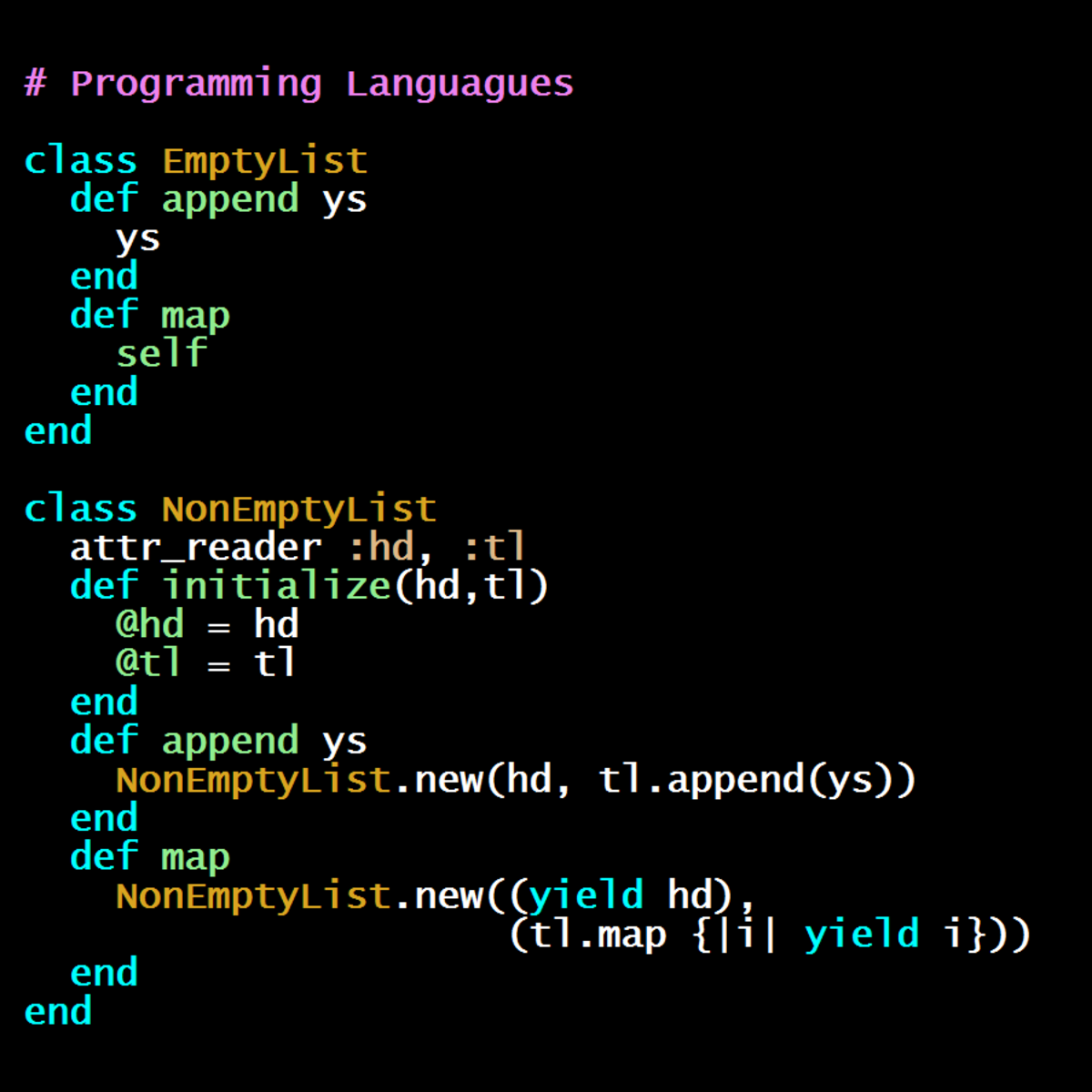
Programming Languages, Part C
Skills:
Reading ML Papers60%
[As described below, this is Part C of a 3-part course. Participants should complete Parts A and B first -- Part C "dives right in" and refers often to material from Part A and Part B.]
This course is an introduction to the basic concepts of programming languages, with a strong emphasis on functional programming. The course uses the languages ML, Racket, and Ruby as vehicles for teaching the concepts, but the real intent is to teach enough about how any language “fits together” to make you more effective programming in any language -- and in learning new ones.
This course is neither particularly theoretical nor just about programming specifics -- it will give you a framework for understanding how to use language constructs effectively and how to design correct and elegant programs. By using different languages, you will learn to think more deeply than in terms of the particular syntax of one language. The emphasis on functional programming is essential for learning how to write robust, reusable, composable, and elegant programs. Indeed, many of the most important ideas in modern languages have their roots in functional programming. Get ready to learn a fresh and beautiful way to look at software and how to have fun building it.
The course assumes some prior experience with programming, as described in more detail in the first module of Part A. Part B assumes successful completion of Part A.
The course is divided into three Coursera courses: Part A, Part B, and Part C. As explained in more detail in the first module of Part A, the overall course is a substantial amount of challenging material, so the three-part format provides two intermediate milestones and opportunities for a pause before continuing. The three parts are designed to be completed in order and set up to motivate you to continue through to the end of Part C.
Week 1 of Part A has a more detailed list of topics for all three parts of the course, but it is expected that most course participants
Watch on External: Coursera ↗
(saves to browser)
Sign in to unlock AI tutor explanation · ⚡30
More on: Reading ML Papers
View skill →




Related AI Lessons
⚡
⚡
⚡
⚡
I Spent Weeks Looking for a Research Gap Before I Realized I Was Searching the Wrong Way
Medium · AI
ICMI 2026 Reviews [D]
Reddit r/MachineLearning
Workshop submission for main conference paper under review [D]
Reddit r/MachineLearning
Kept context-switching between arxiv, OpenReview, GitHub, and HuggingFace for every paper, so I built this. Chrome extension + website with everything inline, plus citation graph + SPECTER2 neighbors. 3M papers, free, feedback welcome [P]
Reddit r/MachineLearning
🎓
Tutor Explanation

 DeepCamp AI