Scaling PyTorch Model Training With Minimal Code Changes
Sebastian's books: https://sebastianraschka.com/books/
Code examples: https://github.com/rasbt/cvpr2023
In this short tutorial, I will show you how to accelerate the training of LLMs and Vision Transformers with minimal code changes using open-source libraries.
---
To support this channel, please consider purchasing a copy of my books: https://sebastianraschka.com/books/
---
https://x.com/rasbt
https://linkedin.com/in/sebastianraschka/
https://magazine.sebastianraschka.com
Watch on YouTube ↗
(saves to browser)
Sign in to unlock AI tutor explanation · ⚡30
Playlist
Uploads from Sebastian Raschka · Sebastian Raschka · 0 of 60
← Previous
Next →
1
![Intro to Deep Learning -- L06.5 Cloud Computing [Stat453, SS20]](https://i.ytimg.com/vi/9eH1SAs8K3o/mqdefault.jpg) 2
2
![Intro to Deep Learning -- L09 Regularization [Stat453, SS20]](https://i.ytimg.com/vi/KwaxQKiLkFY/mqdefault.jpg) 3
3
![Intro to Deep Learning -- L10 Input and Weight Normalization Part 1/2 [Stat453, SS20]](https://i.ytimg.com/vi/QQD9Y2FiotQ/mqdefault.jpg) 4
4
![Intro to Deep Learning -- L10 Input and Weight Normalization Part 2/2 [Stat453, SS20]](https://i.ytimg.com/vi/H_hrdUUrjho/mqdefault.jpg) 5
5
![Intro to Deep Learning -- L11 Common Optimization Algorithms [Stat453, SS20]](https://i.ytimg.com/vi/MyWwxEHC5zE/mqdefault.jpg) 6
6
![Intro to Deep Learning -- L12 Intro to Convolutional Neural Networks (Part 1) [Stat453, SS20]](https://i.ytimg.com/vi/7ftuaShIzhc/mqdefault.jpg) 7
7
![Intro to Deep Learning -- L13 Intro to Convolutional Neural Networks (Part 2) 1/2 [Stat453, SS20]](https://i.ytimg.com/vi/mZmyp0JjH6s/mqdefault.jpg) 8
8
![Intro to Deep Learning -- L13 Intro to Convolutional Neural Networks (Part 2) 2/2 [Stat453, SS20]](https://i.ytimg.com/vi/ji05GxulVuY/mqdefault.jpg) 9
9
![Intro to Deep Learning -- L14 Intro to Recurrent Neural Networks [Stat453, SS20]](https://i.ytimg.com/vi/tFWex9e-sg8/mqdefault.jpg) 10
10
![Intro to Deep Learning -- L15 Autoencoders [Stat453, SS20]](https://i.ytimg.com/vi/iddlDHXDxc0/mqdefault.jpg) 11
11
![Intro to Deep Learning -- L16 Generative Adversarial Networks [Stat453, SS20]](https://i.ytimg.com/vi/aka29GqbsEM/mqdefault.jpg) 12
12
![Intro to Deep Learning -- Student Presentations, Day 1 [Stat453, SS20]](https://i.ytimg.com/vi/e_I0q3mmfw4/mqdefault.jpg) 13
13
 14
14
 15
15
 16
16
 17
17
 18
18
 19
19
 20
20
 21
21
 22
22
 23
23
 24
24
 25
25
 26
26
 27
27
 28
28
 29
29
 30
30
 31
31
 32
32
 33
33
 34
34
 35
35
 36
36
 37
37
 38
38
 39
39
 40
40
 41
41
 42
42
 43
43
 44
44
 45
45
 46
46
 47
47
 48
48
 49
49
 50
50
 51
51
 52
52
 53
53
 54
54
 55
55
 56
56
 57
57
 58
58
 59
59
 60
60

Intro to Deep Learning -- L06.5 Cloud Computing [Stat453, SS20]
Sebastian Raschka
Intro to Deep Learning -- L09 Regularization [Stat453, SS20]
Sebastian Raschka
Intro to Deep Learning -- L10 Input and Weight Normalization Part 1/2 [Stat453, SS20]
Sebastian Raschka
Intro to Deep Learning -- L10 Input and Weight Normalization Part 2/2 [Stat453, SS20]
Sebastian Raschka
Intro to Deep Learning -- L11 Common Optimization Algorithms [Stat453, SS20]
Sebastian Raschka
Intro to Deep Learning -- L12 Intro to Convolutional Neural Networks (Part 1) [Stat453, SS20]
Sebastian Raschka
Intro to Deep Learning -- L13 Intro to Convolutional Neural Networks (Part 2) 1/2 [Stat453, SS20]
Sebastian Raschka
Intro to Deep Learning -- L13 Intro to Convolutional Neural Networks (Part 2) 2/2 [Stat453, SS20]
Sebastian Raschka
Intro to Deep Learning -- L14 Intro to Recurrent Neural Networks [Stat453, SS20]
Sebastian Raschka
Intro to Deep Learning -- L15 Autoencoders [Stat453, SS20]
Sebastian Raschka
Intro to Deep Learning -- L16 Generative Adversarial Networks [Stat453, SS20]
Sebastian Raschka
Intro to Deep Learning -- Student Presentations, Day 1 [Stat453, SS20]
Sebastian Raschka
1.2 What is Machine Learning (L01: What is Machine Learning)
Sebastian Raschka
1.3 Categories of Machine Learning (L01: What is Machine Learning)
Sebastian Raschka
1.4 Notation (L01: What is Machine Learning)
Sebastian Raschka
1.1 Course overview (L01: What is Machine Learning)
Sebastian Raschka
1.5 ML application (L01: What is Machine Learning)
Sebastian Raschka
1.6 ML motivation (L01: What is Machine Learning)
Sebastian Raschka
2.1 Introduction to NN (L02: Nearest Neighbor Methods)
Sebastian Raschka
2.2 Nearest neighbor decision boundary (L02: Nearest Neighbor Methods)
Sebastian Raschka
2.3 K-nearest neighbors (L02: Nearest Neighbor Methods)
Sebastian Raschka
2.4 Big O of K-nearest neighbors (L02: Nearest Neighbor Methods)
Sebastian Raschka
2.5 Improving k-nearest neighbors (L02: Nearest Neighbor Methods)
Sebastian Raschka
2.6 K-nearest neighbors in Python (L02: Nearest Neighbor Methods)
Sebastian Raschka
3.1 (Optional) Python overview
Sebastian Raschka
3.2 (Optional) Python setup
Sebastian Raschka
3.3 (Optional) Running Python code
Sebastian Raschka
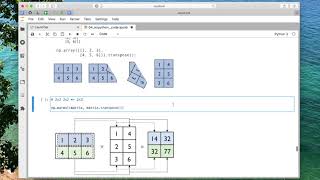
4.1 Intro to NumPy (L04: Scientific Computing in Python)
Sebastian Raschka
4.2 NumPy Array Construction and Indexing (L04: Scientific Computing in Python)
Sebastian Raschka
4.4 NumPy Broadcasting (L04: Scientific Computing in Python)
Sebastian Raschka
4.5 NumPy Advanced Indexing -- Memory Views and Copies (L04: Scientific Computing in Python)
Sebastian Raschka
4.3 NumPy Array Math and Universal Functions (L04: Scientific Computing in Python)
Sebastian Raschka
4.7 Reshaping NumPy Arrays (L04: Scientific Computing in Python)
Sebastian Raschka
4.6 NumPy Random Number Generators (L04: Scientific Computing in Python)
Sebastian Raschka
4.8 NumPy Comparison Operators and Masks (L04: Scientific Computing in Python)
Sebastian Raschka
4.9 NumPy Linear Algebra Basics (L04: Scientific Computing in Python)
Sebastian Raschka
4.10 Matplotlib (L04: Scientific Computing in Python)
Sebastian Raschka
5.1 Reading a Dataset from a Tabular Text File (L05: Machine Learning with Scikit-Learn)
Sebastian Raschka
5.2 Basic data handling (L05: Machine Learning with Scikit-Learn)
Sebastian Raschka
5.3 Object Oriented Programming & Python Classes (L05: Machine Learning with Scikit-Learn)
Sebastian Raschka
5.4 Intro to Scikit-learn (L05: Machine Learning with Scikit-Learn)
Sebastian Raschka
5.5 Scikit-learn Transformer API (L05: Machine Learning with Scikit-Learn)
Sebastian Raschka
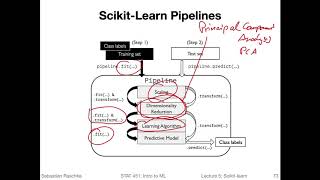
5.6 Scikit-learn Pipelines (L05: Machine Learning with Scikit-Learn)
Sebastian Raschka
6.1 Intro to Decision Trees (L06: Decision Trees)
Sebastian Raschka
6.2 Recursive algorithms & Big-O (L06: Decision Trees)
Sebastian Raschka
6.3 Types of decision trees (L06: Decision Trees)
Sebastian Raschka
6.5 Gini & Entropy versus misclassification error (L06: Decision Trees)
Sebastian Raschka
6.6 Improvements & dealing with overfitting (L06: Decision Trees)
Sebastian Raschka
6.7 Code Example Implementing Decision Trees in Scikit-Learn (L06: Decision Trees)
Sebastian Raschka
7.1 Intro to ensemble methods (L07: Ensemble Methods)
Sebastian Raschka
7.2 Majority Voting (L07: Ensemble Methods)
Sebastian Raschka
7.3 Bagging (L07: Ensemble Methods)
Sebastian Raschka
7.4 Boosting and AdaBoost (L07: Ensemble Methods)
Sebastian Raschka
7.5 Gradient Boosting (L07: Ensemble Methods)
Sebastian Raschka
7.6 Random Forests (L07: Ensemble Methods)
Sebastian Raschka
7.7 Stacking (L07: Ensemble Methods)
Sebastian Raschka
8.1 Intro to overfitting and underfitting (L08: Model Evaluation Part 1)
Sebastian Raschka
8.2 Intuition behind bias and variance (L08: Model Evaluation Part 1)
Sebastian Raschka
8.3 Bias-Variance Decomposition of the Squared Error (L08: Model Evaluation Part 1)
Sebastian Raschka
8.4 Bias and Variance vs Overfitting and Underfitting (L08: Model Evaluation Part 1)
Sebastian Raschka
More on: LLM Foundations
View skill →





![Run Any AI LOCALLY for FREE Forever! [100% Beginner Tutorial]](https://i.ytimg.com/vi/8GFPZRgtEn8/mqdefault.jpg)


Related AI Lessons
⚡
⚡
⚡
⚡
Read the Paper, Write the Code: Agentic Reproduction of Social-Science Results
ArXiv cs.AI
Memanto: Typed Semantic Memory with Information-Theoretic Retrieval for Long-Horizon Agents
ArXiv cs.AI
When Does LLM Self-Correction Help? A Control-Theoretic Markov Diagnostic and Verify-First Intervention
ArXiv cs.AI
Introducing Background Temperature to Characterise Hidden Randomness in Large Language Models
ArXiv cs.AI
🎓
Tutor Explanation

 DeepCamp AI