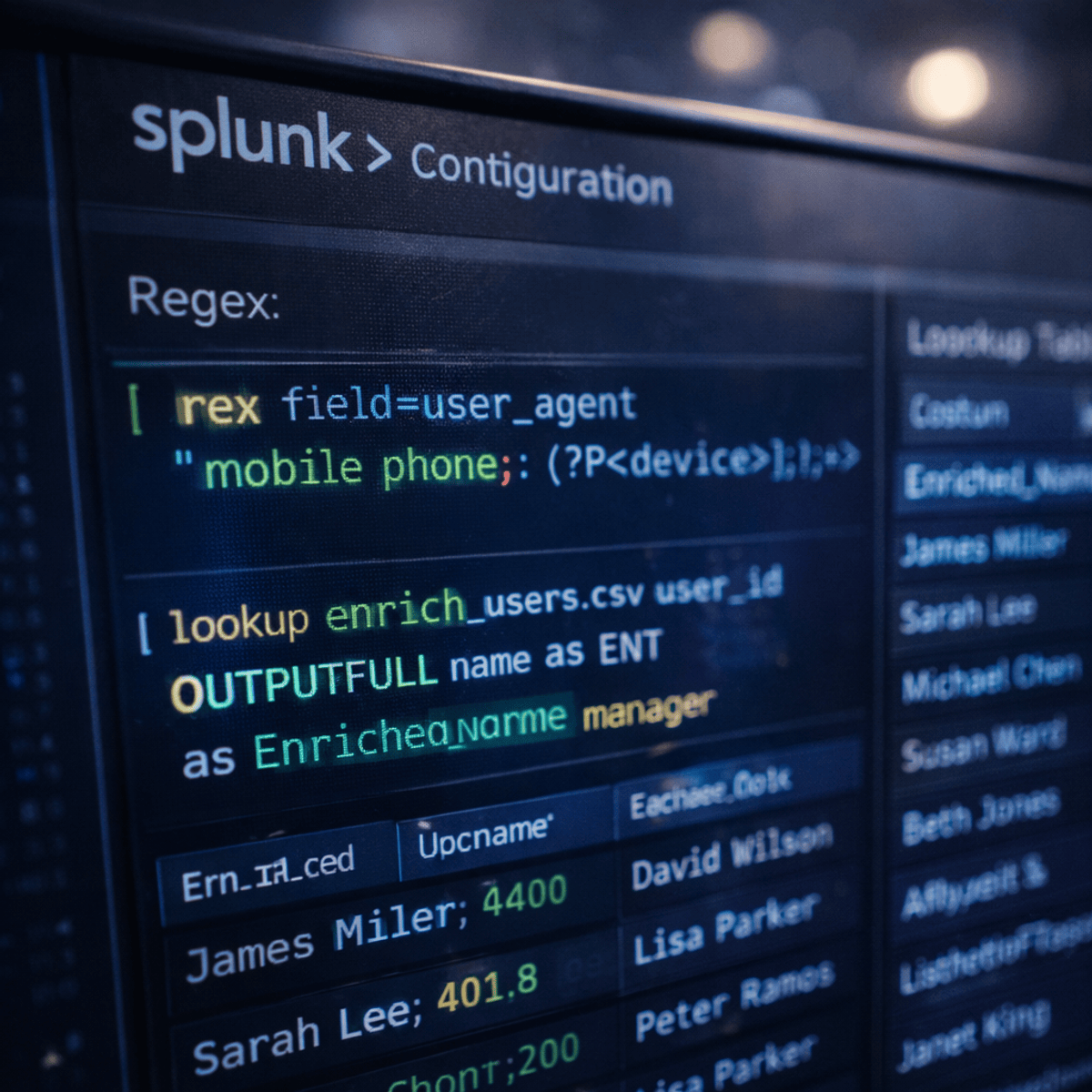
Apply Splunk Data Transformation and Distributed Search
Skills:
Systems Design Basics80%
Key Takeaways
Teaches Splunk data transformation, distributed search, and secure access controls for scalable environments
Original Description
By the end of this course, learners will be able to manipulate raw data in Splunk, apply regex-based transformations, configure indexing and metadata, enrich events using lookups, enforce secure access controls, and implement distributed search architectures for scalable environments. Learners will also gain the ability to evaluate standalone versus distributed deployments and apply best practices for secure, high-availability search operations.
This course equips learners with practical, job-ready skills required to manage real-world Splunk environments. Through hands-on projects and structured lessons, learners will understand how raw machine data is transformed into reliable, searchable insights and how enriched data improves analysis and decision-making. The course also builds strong competency in securing Splunk deployments by applying role-based access control, capabilities, and risk mitigation strategies.
What makes this course unique is its end-to-end, project-driven approach that connects data ingestion, transformation, enrichment, and distributed architecture into a single cohesive learning journey. Rather than focusing only on search commands, the course emphasizes foundational configuration, security, and scalability concepts that are critical for enterprise Splunk implementations, making it ideal for learners seeking applied Splunk administration and data engineering expertise.
Watch on External: Coursera ↗
(saves to browser)
Sign in to unlock AI tutor explanation · ⚡30
More on: Systems Design Basics
View skill →








Related Reads
📰
📰
📰
📰
Designing DynamoDB: A Distributed Key-Value Store at Any Scale
Dev.to · RONI DAS
9 Things Developers Confidently Say About "It Runs Entirely in the Browser"
Dev.to · Vijay Kanna
Designing High-Resiliency Cross-Platform Apps (And How to Test Them)
Dev.to · Gabriel Madichie
System Design - Building an Experiment Service
Dev.to · ICraftCode
🎓
Tutor Explanation
 DeepCamp AI