Mesh LLM: distributed AI computing on iroh
📰 Hacker News (AI)
Learn how Mesh LLM enables distributed AI computing on iroh, allowing teams to run large language models on their own hardware and reducing costs
Action Steps
- Sign up for an iroh account to access Mesh LLM
- Install the iroh client on your local machine
- Configure the Mesh LLM plugin to distribute model compute across multiple endpoints
- Test the setup by running a large language model on the mesh
- Use the OpenAI-compatible API to integrate Mesh LLM with your existing applications
Who Needs to Know This
Developers and data scientists working with large language models can benefit from Mesh LLM's ability to distribute compute across multiple machines, providing more control and lower costs
Key Insight
💡 Mesh LLM allows teams to pool their existing GPUs and memory across multiple machines, exposing them as a single OpenAI-compatible API
Share This
🚀 Run large language models on your own hardware with Mesh LLM! 🤖
Key Takeaways
Learn how Mesh LLM enables distributed AI computing on iroh, allowing teams to run large language models on their own hardware and reducing costs
Full Article
Title: Mesh LLM: distributed AI computing on iroh
URL Source: https://www.iroh.computer/blog/mesh-llm
Markdown Content:
[🎉 version 1.0 is here!Read the blog post](https://www.iroh.computer/blog/v1)
Open main menu
[](https://www.iroh.computer/)
* Services
* Use Cases
* [Docs](https://docs.iroh.computer/)
* [Blog](https://www.iroh.computer/blog)
* [Pricing](https://www.iroh.computer/pricing)
* [Sign Up](https://services.iroh.computer/?utm_source=website&utm_content=nav-signup)
* [10k](https://github.com/n0-computer/iroh)
Services[Hosting](https://www.iroh.computer/services/hosting)[Observability](https://www.iroh.computer/services/observability)[Enterprise](https://www.iroh.computer/services/enterprise)
Use Cases[Distributed AI](https://www.iroh.computer/solutions/distributed-ai)[Video Streaming](https://www.iroh.computer/solutions/rave)[Real-time Sync](https://www.iroh.computer/solutions/delta-chat)[Payments & POS](https://www.iroh.computer/solutions/pos)[IoT & Embedded](https://www.iroh.computer/solutions/iot)
[Docs](https://docs.iroh.computer/)[Blog](https://www.iroh.computer/blog)[Pricing](https://www.iroh.computer/pricing)
[Blog Index](https://www.iroh.computer/blog)
# Mesh LLM: distributed AI computing on iroh
July 11, 2026 by n0 team
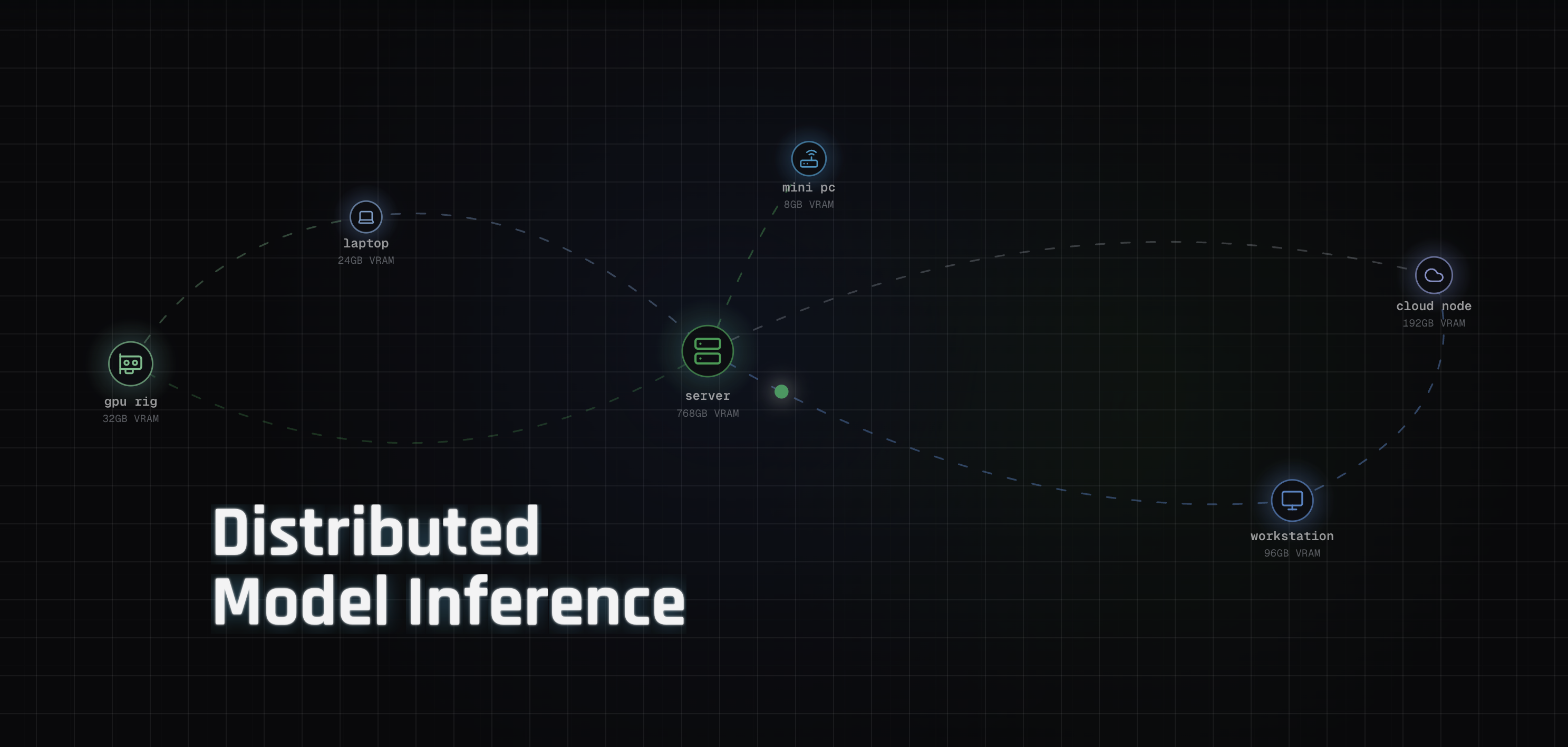
When people picture running a large language model, they picture a data center. Racks of GPUs that belong to someone else, a metered API, and a bill that grows every month you succeed. You send your prompts off to a black box and hope the price, the model, and the privacy policy all stay the way they were when you signed up.
For a lot of teams that is a bad trade. You give up control over when models change, where your data goes, and what hardware runs your workloads. And as usage grows, so does the bill, with no lever to pull except "pay more."
[Mesh LLM](https://meshllm.cloud/) is a different shape. It pools the GPUs and memory you already have, across as many machines as you want to add, and exposes the whole thing as one OpenAI-compatible API. Start one node. Add more later. Let the mesh decide whether a model runs on the box in front of you, routes to a peer, or splits across several machines.
## [The problem: AI is expensive, and it is somebody else's](https://www.iroh.computer/blog/mesh-llm#the-problem-ai-is-expensive-and-it-is-somebody-elses)
The popular models are monoliths. Most people reach them through a UI or an API key and pay a large provider to run everything. That is convenient, and it is also a surrender. You do not control when the model gets updated, what memory it runs in, or what hardware sits underneath.
Plenty of businesses and services that depend on these models want the opposite: more control, more pluggability, lower cost. They have GPUs sitting in offices, in closets, under desks. What they are missing is a way to make those machines act like one.
## [Mesh LLM: run the models yourself](https://www.iroh.computer/blog/mesh-llm#mesh-llm-run-the-models-yourself)
The pitch is simple. Run bigger models without buying bigger GPUs. Share compute privately with your team, or publicly with the world, to power agents and chat. Point any OpenAI client at [http://localhost:9337/v1](http://localhost:9337/v1) and stop caring where the work actually happens.
Under the hood, Mesh LLM distributes model compute across a mesh of iroh endpoints. A request can be served three ways:
* Run it locally, on this machine's GPU.
* Route it to a peer that already has the model loaded.
* Split a model too big for any single box across several machines, as a pipeline.
## [How it works](https://www.iroh.computer/blog/mesh-llm#how-it-works)
The architecture is pluggable. Plugins decl
URL Source: https://www.iroh.computer/blog/mesh-llm
Markdown Content:
[🎉 version 1.0 is here!Read the blog post](https://www.iroh.computer/blog/v1)
Open main menu
[](https://www.iroh.computer/)
* Services
* Use Cases
* [Docs](https://docs.iroh.computer/)
* [Blog](https://www.iroh.computer/blog)
* [Pricing](https://www.iroh.computer/pricing)
* [Sign Up](https://services.iroh.computer/?utm_source=website&utm_content=nav-signup)
* [10k](https://github.com/n0-computer/iroh)
Services[Hosting](https://www.iroh.computer/services/hosting)[Observability](https://www.iroh.computer/services/observability)[Enterprise](https://www.iroh.computer/services/enterprise)
Use Cases[Distributed AI](https://www.iroh.computer/solutions/distributed-ai)[Video Streaming](https://www.iroh.computer/solutions/rave)[Real-time Sync](https://www.iroh.computer/solutions/delta-chat)[Payments & POS](https://www.iroh.computer/solutions/pos)[IoT & Embedded](https://www.iroh.computer/solutions/iot)
[Docs](https://docs.iroh.computer/)[Blog](https://www.iroh.computer/blog)[Pricing](https://www.iroh.computer/pricing)
[Blog Index](https://www.iroh.computer/blog)
# Mesh LLM: distributed AI computing on iroh
July 11, 2026 by n0 team

When people picture running a large language model, they picture a data center. Racks of GPUs that belong to someone else, a metered API, and a bill that grows every month you succeed. You send your prompts off to a black box and hope the price, the model, and the privacy policy all stay the way they were when you signed up.
For a lot of teams that is a bad trade. You give up control over when models change, where your data goes, and what hardware runs your workloads. And as usage grows, so does the bill, with no lever to pull except "pay more."
[Mesh LLM](https://meshllm.cloud/) is a different shape. It pools the GPUs and memory you already have, across as many machines as you want to add, and exposes the whole thing as one OpenAI-compatible API. Start one node. Add more later. Let the mesh decide whether a model runs on the box in front of you, routes to a peer, or splits across several machines.
## [The problem: AI is expensive, and it is somebody else's](https://www.iroh.computer/blog/mesh-llm#the-problem-ai-is-expensive-and-it-is-somebody-elses)
The popular models are monoliths. Most people reach them through a UI or an API key and pay a large provider to run everything. That is convenient, and it is also a surrender. You do not control when the model gets updated, what memory it runs in, or what hardware sits underneath.
Plenty of businesses and services that depend on these models want the opposite: more control, more pluggability, lower cost. They have GPUs sitting in offices, in closets, under desks. What they are missing is a way to make those machines act like one.
## [Mesh LLM: run the models yourself](https://www.iroh.computer/blog/mesh-llm#mesh-llm-run-the-models-yourself)
The pitch is simple. Run bigger models without buying bigger GPUs. Share compute privately with your team, or publicly with the world, to power agents and chat. Point any OpenAI client at [http://localhost:9337/v1](http://localhost:9337/v1) and stop caring where the work actually happens.
Under the hood, Mesh LLM distributes model compute across a mesh of iroh endpoints. A request can be served three ways:
* Run it locally, on this machine's GPU.
* Route it to a peer that already has the model loaded.
* Split a model too big for any single box across several machines, as a pipeline.
## [How it works](https://www.iroh.computer/blog/mesh-llm#how-it-works)
The architecture is pluggable. Plugins decl





 DeepCamp AI